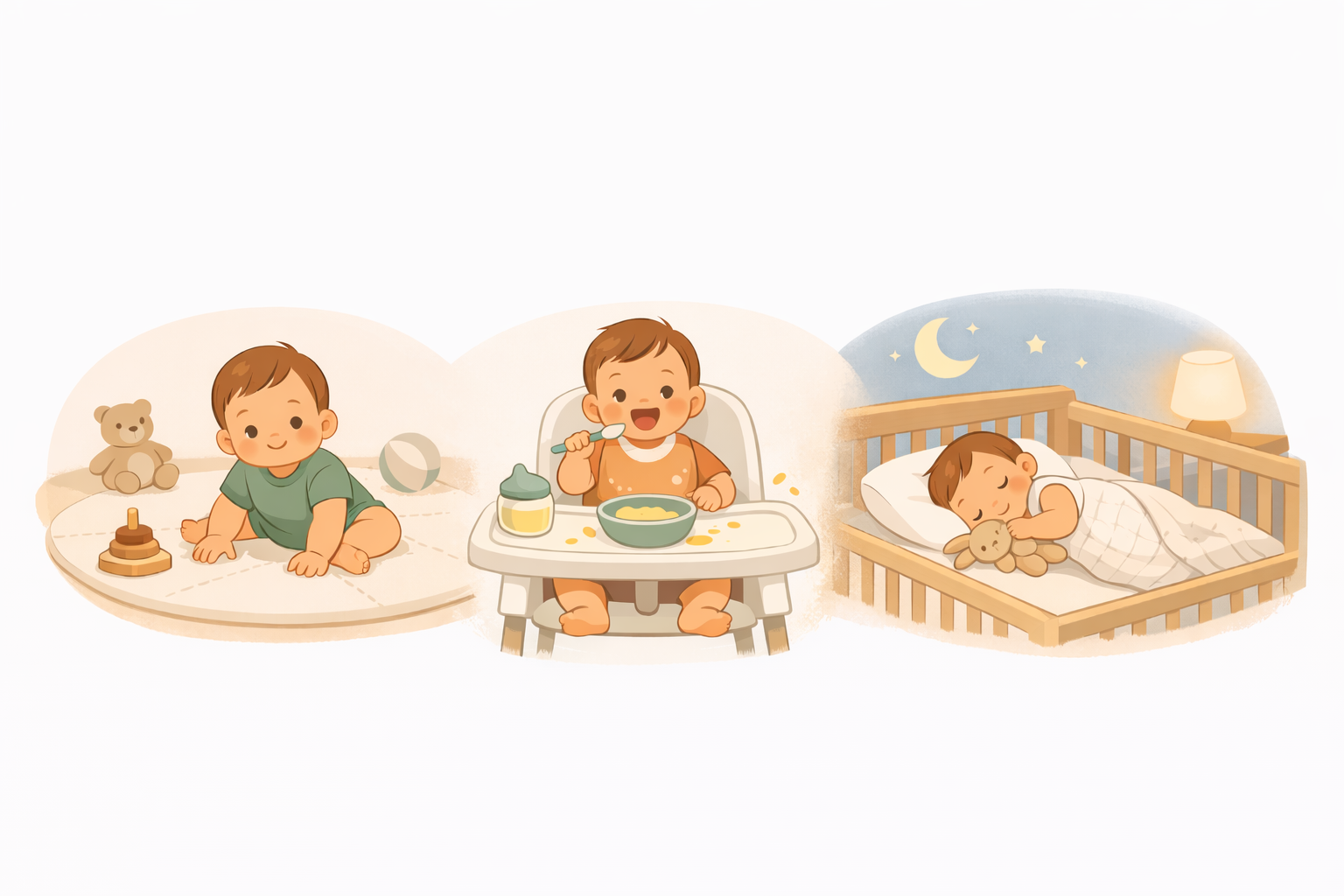
Somewhere around six months, you suddenly realise your baby isn’t a tiny newborn anymore.
They’re trying to sit up every time you lay them down. They’re grabbing at your plate. They’re looking at you like they have opinions now.
At 6 months, baby development starts to feel different. Not dramatic. Just… noticeable.
This is usually the stage where three things take centre stage: sitting, starting solids, and sleep doing its own unpredictable thing.
If you’ve been wondering, “Are we on track?” — you’re not alone. I asked myself that at least ten times a week.
6 Month Baby Sitting: The Wobble Phase
One day they’re rolling. The next day they’re trying to push themselves upright like they’ve decided lying down is beneath them.
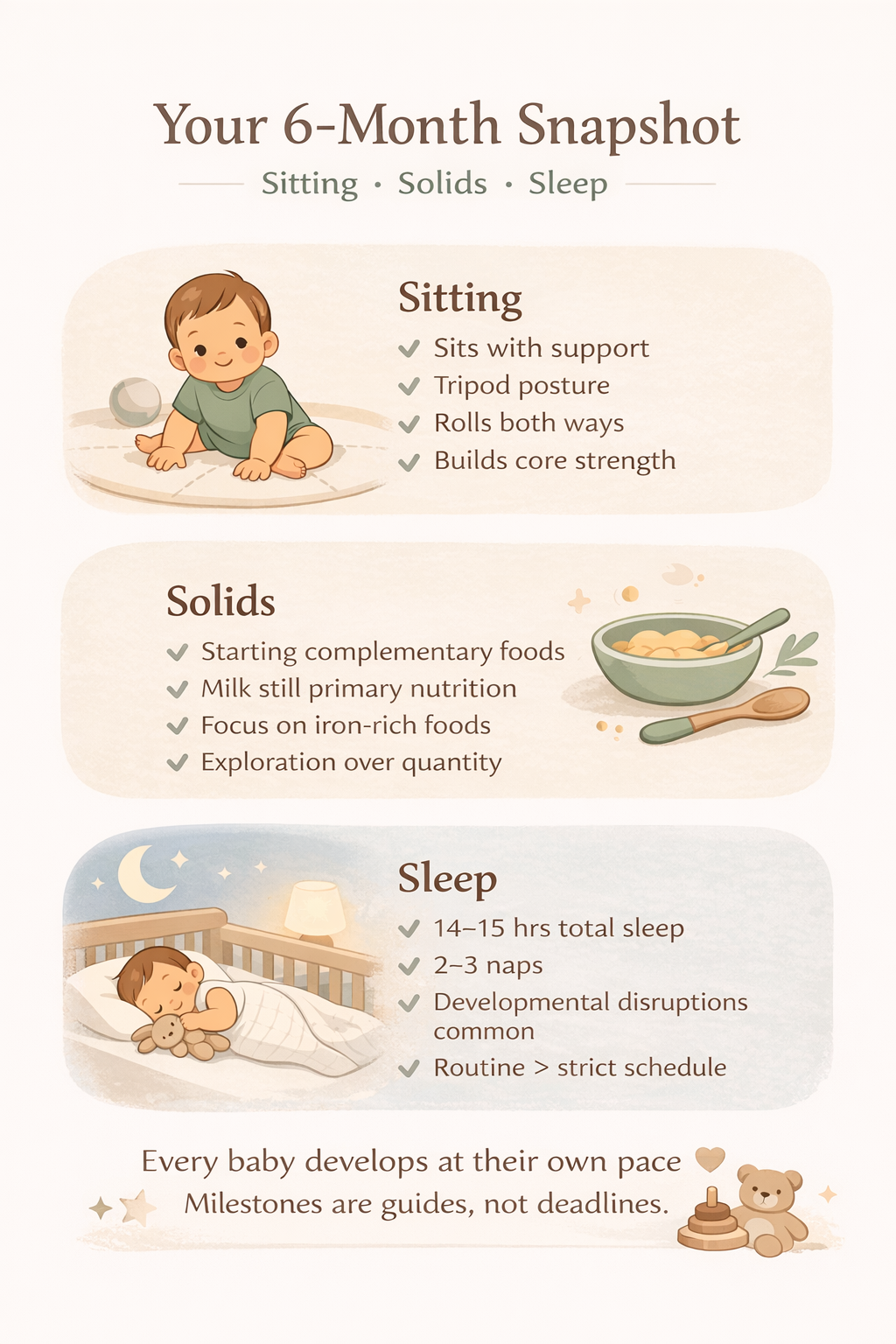
At this stage, 6 month baby sitting skills begin to strengthen. You’ll often see them leaning forward on their hands — that little tripod pose. They wobble. They topple. Sometimes they look surprised when they fall.
And then they try again.
That’s the part that gets me — how determined they are.
You don’t really need fancy equipment here. Floor time works wonders. Let them explore. Let them shift their weight. Let them figure it out. The wobbling is part of the learning.
Some babies sit independently closer to seven months. Some a little earlier. There’s a range. I had to remind myself of that constantly.
What matters more than the exact timing is progress — stronger neck control, better balance, more confidence.
And honestly? Once they sit, everything changes. They can see more. Reach more. Play differently. It’s like their world expands overnight.
Solids: More Mess Than Meals
Starting solids at 6 months is often one of the biggest milestones. And it is. But it’s also… chaotic.
At six months, milk (breastmilk or formula) is still their main nutrition. Solids are more about learning — textures, tastes, how to move food around in their mouth.
The first time I offered food, I expected a magical moment.
Instead, there was a confused face. A spit-out spoon. And sweet potato everywhere.
That’s normal.
Some babies dive right in. Others take their time. Some days they eat surprisingly well. Other days they just smear food across the tray and call it a day.
If your baby can sit with support, has good head control, and seems interested when you eat — those are good signs they’re ready.
Iron-rich foods become important around this age because their natural iron stores start dropping. Lentils, beans, fortified cereals, mashed vegetables — simple is fine.
And if you’re anxious about gagging, you’re not alone. It looks scary. But gagging is usually a protective reflex while they learn. Choking is silent and very different — it’s worth knowing the difference so you feel more confident.
Mostly, though, this stage is about patience. And laundry.
Sleep: Just When You Think You’ve Figured It Out
If sleep was improving before six months… it might shift again.
If sleep was already hard… it might stay hard.
Or it might suddenly get better.
There’s no single script here.
Around this age, babies are developing so quickly — physically and mentally. They’re rolling more, trying to sit, noticing when you leave the room. All of that can show up in their sleep.
Many six-month-olds need about 14–15 hours of total sleep in 24 hours. Some drop to two naps. Some hold onto three a bit longer.
We found that consistency helped more than chasing perfect schedules. A predictable bedtime routine — even something simple — made a difference. Bath, feed, dim lights, same song every night.
But I also learned that sleep changes. Just when you feel confident, something shifts again.
It doesn’t mean you’re doing it wrong.
The Quiet Pressure Around Milestones
Six months is when comparisons can creep in.
Someone’s baby is sitting independently. Someone’s baby is sleeping through the night. Someone’s baby is eating everything offered.
And then you look at your own child and wonder.
I had to keep reminding myself: development isn’t a race. It’s not linear either. Babies focus on different skills at different times.
If your baby is slowly getting stronger, more curious, more engaged — that’s growth.
Of course, if something feels off — very stiff muscles, very floppy tone, not attempting to roll either way, limited interaction — it’s always okay to check with your pediatrician. Most often, you’ll just walk away reassured.
What Six Months Really Feels Like
It feels like:
Wobbly sitting.
Messy mealtimes.
Sleep that keeps you guessing.
A baby who suddenly feels bigger.
It’s a stage of becoming — for them and for you.
And if your house feels a little messier and your routines a little shakier right now, you’re probably right where you’re meant to be.