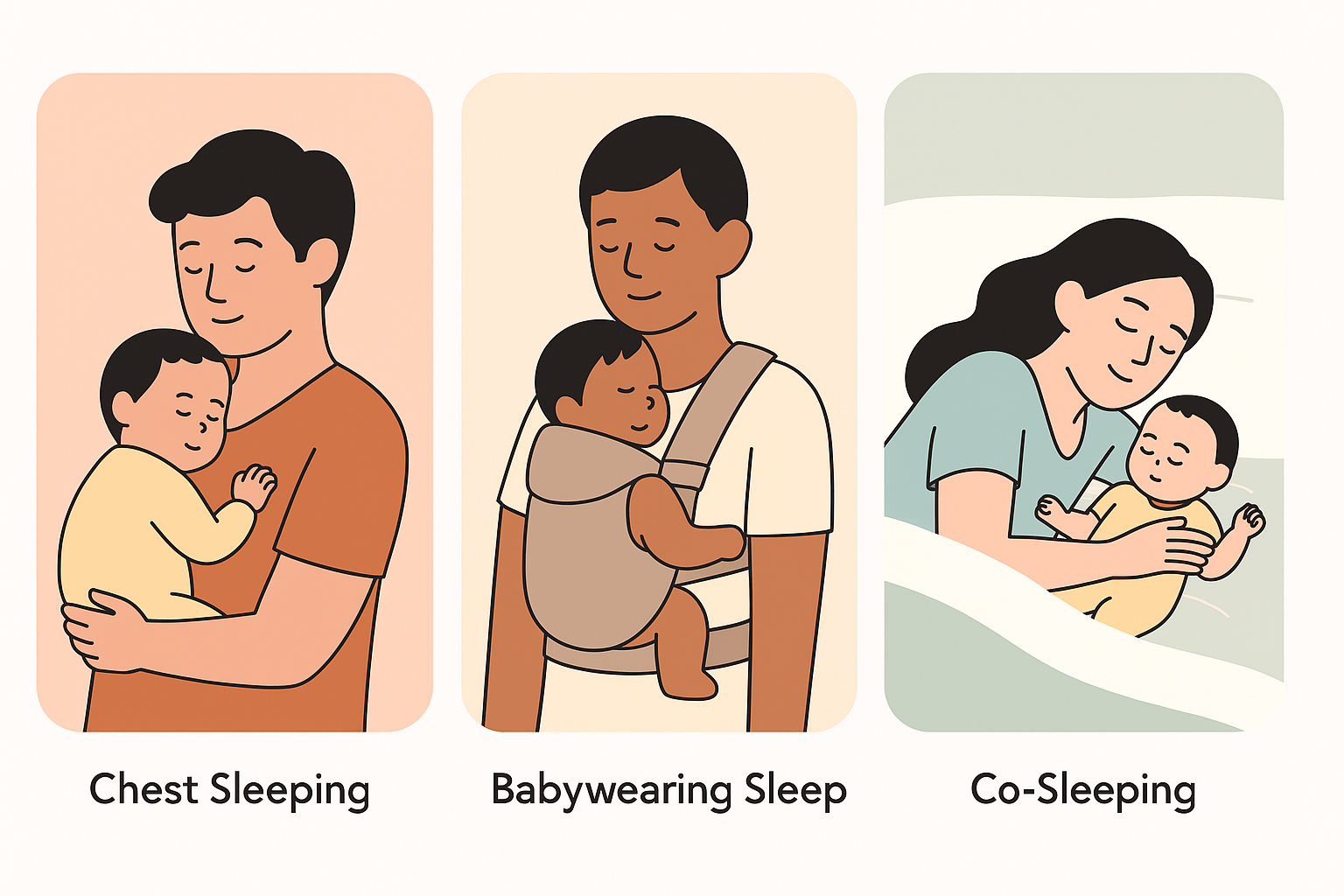
When you become a new parent, one of the most confusing parts of early days is figuring out how your baby prefers to sleep—and how to keep them safe while doing it. Terms like chest sleeping, babywearing sleep, and co-sleeping get used everywhere, but they don’t mean the same thing. In fact, each one has its own purpose, benefits, and safety rules. Understanding the difference matters, because what’s safe while you’re awake may not be safe at all once you fall asleep.
Let’s break down these three forms of close-contact sleep in a simple, clear way.
Chest Sleeping
Chest sleeping is exactly what it sounds like: your baby rests directly on your chest while you are lying down or reclining. This is one of the most natural and instinctive newborn bonding moments. Babies often settle instantly when placed on a parent’s chest. Their breathing regulates, their heart rate slows, and they feel warm, safe, and connected. Many parents rely on chest sleeping to soothe colicky evenings or offer comfort during growth spurts.
However, chest sleeping is something that should happen only when you are fully awake. It becomes unsafe if you are sleepy or lying somewhere soft where the baby could slip. A tiny shift in your body or a moment of drowsiness can block your baby’s nose or mouth. Chest sleeping is beautiful for bonding but not designed for nighttime sleep.
Baby wearing Sleep
Babywearing sleep looks different but shares that same close-contact bonding. In this case, your baby sleeps inside a carrier—secured against your body, upright, and supported. Many babies nap incredibly well while being worn, and it allows parents to stay mobile, cook, walk, or simply hold their baby hands-free. The upright position can even help reduce reflux symptoms.
But the safety rule here is the same as chest sleeping: babywearing sleep is safe only when the parent is awake and alert. Carriers keep babies in a stable position, but they still depend on you to monitor their breathing and make sure their airway is clear. If an adult falls asleep with a baby in a carrier, the risk of airway obstruction increases.
Babywearing sleep is perfect for daytime contact naps, outings, and fussy periods—but it is not a substitute for nighttime sleep.
Co-sleeping
Co-sleeping is entirely different from both chest sleeping and babywearing sleep because, in this case, the baby is not sleeping on your body but beside you on the same sleep surface. This usually means the baby lies next to you on a firm mattress, often within a protected area or a side-lying crib that attaches to your bed.
Unlike the other two forms of closeness, co-sleeping is the only one that is meant to allow the parent to sleep as well—but only when it’s set up safely. Safe co-sleeping involves a flat, firm mattress; no loose pillows or blankets near the baby; and a parent who is not under the influence of anything that affects alertness. The baby always sleeps on their back in a place that is just right for them.
It’s easier to comfort babies at night when they’re co-sleeping, and both parents and babies can sleep better. When done properly, it can be safe and deeply nurturing.
Understanding the Key Difference
All three sleep arrangements involve closeness and contact, but the distinction is actually very simple:
If the baby is on your body—whether on your chest or in a carrier—you must stay awake.
If the baby is beside you in a safe setup, you can sleep.
Chest sleeping and babywearing sleep are wonderful tools for bonding, regulating newborn emotions, and providing comfort during the day. Co-sleeping, on the other hand, is designed for nighttime rest when everyone needs sleep, as long as the safe sleep guidelines are followed.
When parents understand the specific purpose and safety of each type of sleep, they can confidently choose the right one for the moment—comfort when the baby needs closeness, mobility when the day is busy, and safer shared sleep when the night gets long.
The Final Takeaway
Safe sleep isn’t about finding the “right” way to sleep; it’s about knowing when each type of closeness is best. Your kid needs to feel safe, connected, and comfortable, and simply being there for them is enough. Wearing your baby and sleeping on your chest may be great ways to connect and relax when you’re awake. You and your baby can relax together when it’s time to sleep if you co-sleep safely. Trust your gut, know your limits, and remember that being alert, not perfect, is what keeps you safe while you sleep.