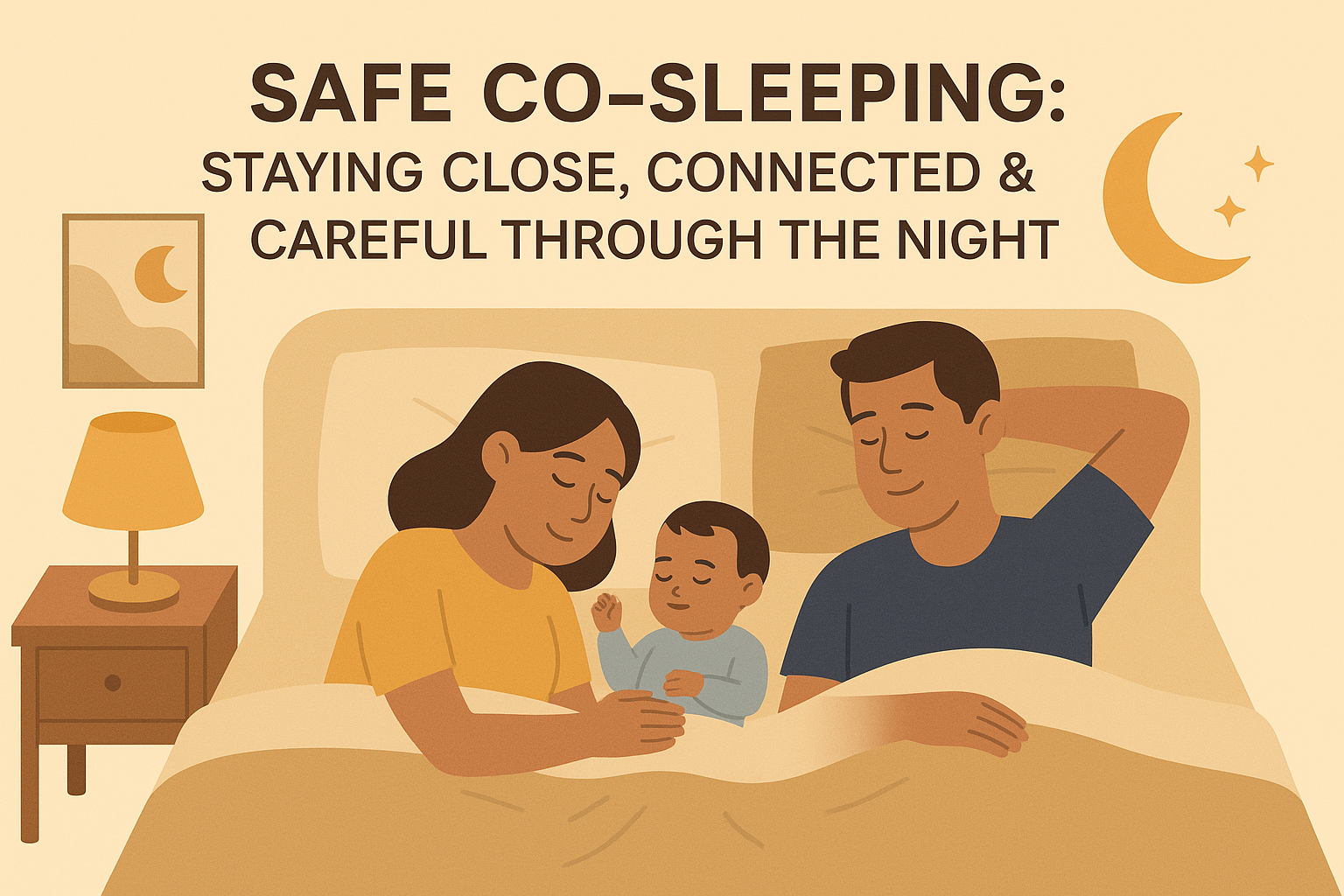
If you read our last blog on Newborn Sleep Safety: How to Set Up a Cozy Baby Sleep Space, you already know how much the nighttime environment matters. Still, many babies sleep best when they’re close to their parents. Whether that happens intentionally or simply in the haze of long nights, co-sleeping is something most families experience. Often, it comes with a mix of comfort and quiet guilt.
This blog opens up that conversation with honesty—explaining what safe co-sleeping really looks like, why it feels so natural, and how you can keep these shared nights connected and safe.
🌙 Co-Sleeping: A Reality Most Parents Eventually Meet
Despite the picture-perfect bassinets we set up before birth, many parents quickly discover that their baby’s favourite place to sleep… is right next to them.
This isn’t a failure or a lack of discipline. It’s just biology.
Babies naturally look for closeness. Your warmth, scent, and the way you breathe make me feel safe. So, when they start protesting the crib at 2 a.m. but melt into sleep the moment they’re on your chest, they aren’t being demanding—they’re following instincts shaped over millions of years.
Parents feel this instinct too. There’s deep reassurance in sensing your baby’s tiny movements, soft breaths, and the way they unconsciously reach for you even in sleep.
The years from 0–3 are a “sensitive window,” when babies spend nearly 70% of their time asleep. Staying close during this phase supports connection, regulation, and emotional security.
💛 What Makes Co-Sleeping Feel So Natural
When co-sleeping is intentional, something intuitive happens. Parents often describe sleeping more lightly and waking just enough to check on their baby, without fully leaving sleep. This half-awake awareness is protective. It keeps you attuned to your child.
For breastfeeding mothers, this instinct is even stronger. Feeding while lying down often leads to a protective C-shaped posture—your arm above the baby and your knees curled below. This isn’t a planned position. Your body simply gravitates toward it.
So, you know, babies that nurse often tend to stay in those lighter sleep cycles, which adds another layer of safety naturally.
Your awareness, along with your baby’s lighter sleep, really creates the perfect base for safe co-sleeping.
🛏️ Preparing the Sleep Space Without “Following Rules”
Co-sleeping safely doesn’t need to be all about following a strict checklist. It’s really about creating a space where your instincts can thrive without any worries.
A firm mattress isn’t a rule—it simply prevents sinking or rolling, so your baby can breathe easily.
Light bedding helps ensure nothing covers your baby during sleepy shifts.
And keeping your baby beside you, instead of between two adults, reduces movement around them through the night.
Anything loose on the bed—extra pillows, soft toys, or folded blankets—can shift without you realising it. Keeping the sleep surface simple helps your natural awareness stay in control.
Some families add a bed rail to create a clear boundary. Others place their mattress directly on the floor, which removes the worry of falls during the months when babies start rolling.
These aren’t tips—they’re gentle explanations of what allows your instincts to function naturally.
Most unsafe situations happen not because families choose to co-sleep, but because they fall asleep unintentionally in unsafe places like couches or recliners. Having a prepared sleep space reduces these risks significantly.
🤱 A Note on Feeding and Nighttime Rhythms
Feeding patterns shape how families sleep. Breastfeeding parents often find co-sleeping develops naturally because babies nurse frequently throughout the night. With the baby nearby, neither of you needs to fully wake for feed.
For bottle-feeding families, closeness can still be deeply comforting. However, babies tend to sleep more deeply and wake less often, which means room-sharing rather than bed-sharing is usually safer. This allows for connection without depending on lighter sleep cycles.
Either way, the goal is always the same: making nights smoother and safer for everyone.
If you use a jhula or hammock, it can be a beautiful way to calm your baby. The gentle motion soothes many little ones instantly. Just keep in mind that these are best used only for settling, not for long or overnight sleep, since they don’t offer a firm, flat, safe surface.
🌙 When Co-Sleeping Happens Accidentally
Even the most careful parents have nights when they lie down to feed and unexpectedly doze off. This is normal. This is also why it helps to treat your bed as a potentially shared sleep space—even if you plan to move your baby back to their crib.
Falling asleep on a sofa or chair is far riskier. So think of your setup not as “I plan to co-sleep,” but as: “If sleep happens here, I want it to be safe.” That simple mindset greatly reduces nighttime risks.
🌼 A Season, Not a Lifetime
Co-sleeping rarely lasts forever. It often supports families through newborn months, regressions, teething, illness, or clingy phases.
Some families return to separate sleep naturally; others continue because it feels right. Some alternate between crib and bed depending on the night.
There is no single correct timeline—only what keeps your family rested and secure.
💫 The Heart of It All
Let’s set aside guilt and judgement for a moment.
You’re not spoiling your baby by keeping them close. You’re not creating “bad habits.” You’re simply responding to a tiny human who has spent more time inside your body than outside it—and who still feels safest near you.
Safe co-sleeping, at its core, is about intentional connection. It’s a deeply human way of sleeping, rooted in care and instinct. When done mindfully, it can be soothing, safe, and beautifully bonding.
You’re doing better than you think. And your baby feels that love every night.