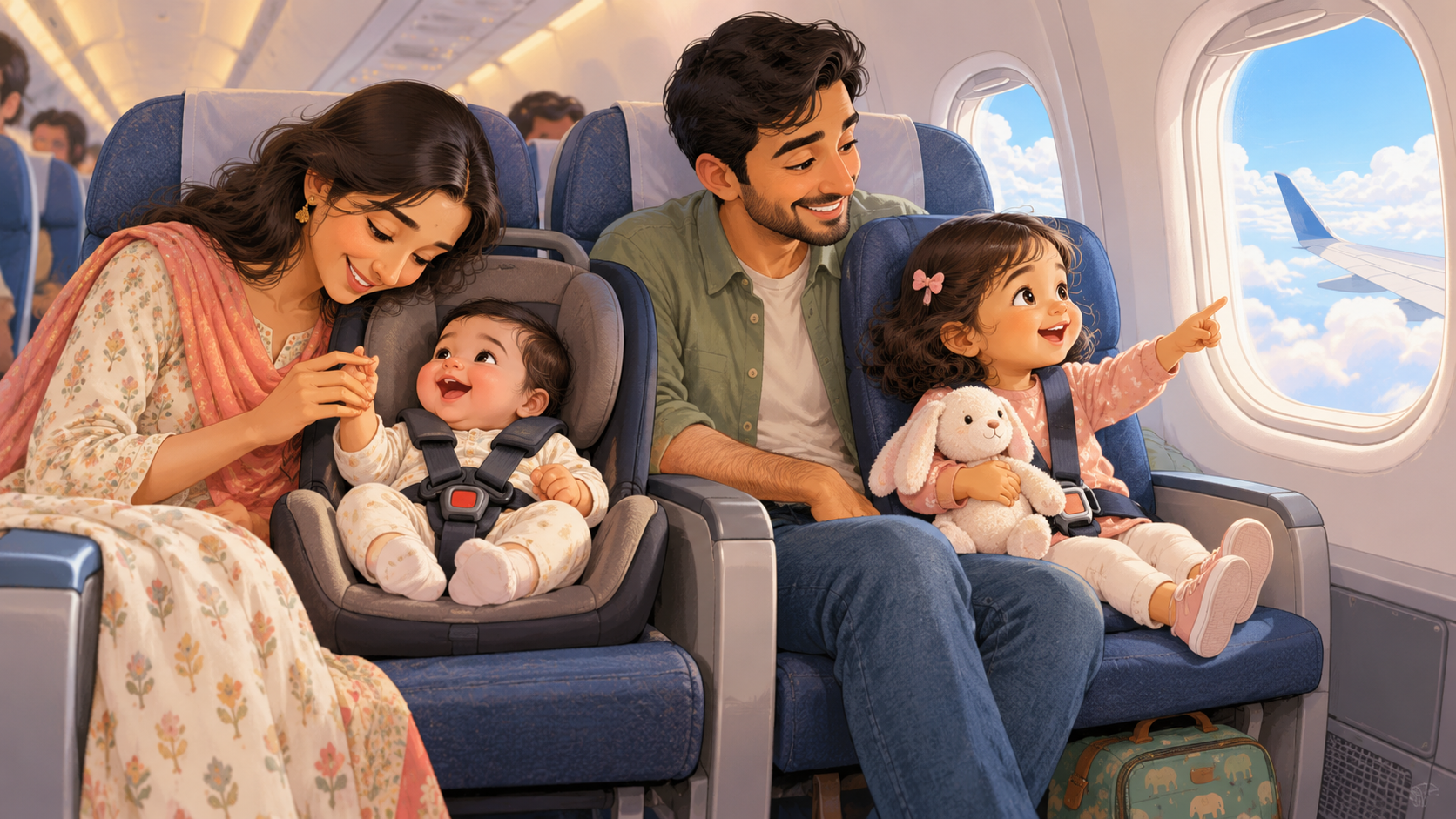
Quick answer: Most Indian airlines allow babies to fly from about 7 days old (some set 14 days), and children under 2 travel as “lap infants” on a small infant fare. Carry the baby’s age proof, feed during take-off and landing to ease ear pressure, keep a separate diaper bag within reach, and gate-check a lightweight stroller. Policies differ by airline, so always confirm before you fly.
Your first flight with a baby can feel like planning a small expedition. The good news: thousands of Indian parents do it every month, and a little preparation takes away most of the stress. This guide covers everything from booking to landing, with practical tips from the IPF parent community.
At a glance: flying with a baby or toddler in India
| Question | Short answer |
|---|---|
| Minimum age to fly | Usually 7 days; some airlines ask for 14 days or a doctor’s fitness letter for very young newborns |
| Who is an “infant”? | A child under 2 years on the date of travel |
| Does the infant get a seat? | No. Infants sit on a parent’s lap, with a separate infant ticket |
| Documents | Birth certificate or accepted age proof (passport and visa for international trips) |
| Stroller | Usually free to gate-check; rules on size and return point vary |
| Best ear-pressure relief | Feeding or sucking during take-off and landing |
| Diaper changing | Most aircraft have a fold-down changing table in at least one lavatory, but not always |
What should you check before booking a flight with a baby?
- Airline infant policy and minimum age. Rules differ slightly between airlines, and young newborns may need a paediatrician’s fitness letter.
- Infant ticket. Under-2s travel on your lap but still need an infant ticket. Age is counted on the date of each flight, so a baby turning 2 mid-trip may need a seat on the return.
- Timings. Pick a flight that fits your baby’s usual sleep and feed schedule where possible.
- Direct over connecting. Fewer take-offs, landings and transfers mean fewer meltdowns.
- Baggage and stroller allowance. Check what is allowed for infants, including baby food, the diaper bag and a stroller.
- Seats. If you can choose, an aisle seat makes it easier to stand, rock and walk with the baby.
If you are travelling with a newborn or a baby with any health concern, talk to your paediatrician before booking.
What should you pack in your cabin bag?
Pack a separate, easy-to-reach diaper bag so you never have to unpack everything mid-flight.
- Diapers (plus extras for delays), wipes, rash cream and disposable changing mats
- Two or three changes of clothes for the baby, and one spare top for you
- Bibs, burp cloths and tissues
- Breast milk, formula, bottles or age-appropriate snacks, plus water
- A comfort toy, blanket or pacifier
- Prescribed medicines and a small first-aid kit
- Wet bags for soiled clothes and diapers
Tip: Keep the things you need most (wipes, a diaper, a pacifier) in the outer pockets.
Can you take a stroller on a flight in India?
Usually yes. Most airlines let you use a stroller until the boarding gate, where staff tag it and carry it in the aircraft hold. This is called gate-checking.
- The stroller normally does not come into the passenger cabin.
- It may be returned at the aircraft door or at the baggage belt, depending on the airline and airport.
- A lightweight, foldable stroller is far easier to manage. Fold it before you reach the gate.
- Ask the gate staff where it will be returned.
IPF parents travelling alone with a baby often call gate-checking the biggest help of all, because you can carry or wheel the baby through the whole airport and only hand over the stroller at the last moment.
How do you ease your baby’s ear pressure during take-off and landing?
Swallowing helps equalize pressure in the ears, so:
- Babies: breastfeed or bottle-feed during take-off and landing.
- Toddlers: offer water, milk or a snack, or a sipper to sip on.
- Pacifiers also encourage swallowing.
- Try not to let a baby sleep through the whole descent if they seem uncomfortable.
- Baby ear muffs are optional, mainly useful for children sensitive to loud noise.
Parents in our community say timing the feed so it starts as the engines get louder works well. Ask the crew if you are unsure when descent begins.
How do you feed a baby on a flight?
- Breastfeeding is generally possible during the flight. A light cover or shawl helps if you want privacy.
- Carry enough formula, expressed milk or baby food for the journey and for delays.
- Do not assume the airline will heat bottles or provide hot water. Ask the crew politely, but plan to manage without.
- For toddlers, pack familiar snacks, finger foods and a spill-proof bottle.
- Follow hunger cues. Flights are not the time to force a meal.
How do you change diapers on a plane?
Most aircraft used for passenger flights have at least one lavatory with a fold-down changing table, but availability varies by aircraft.
- Ask the cabin crew where the changing table is.
- Carry a disposable mat and a small pouch with diaper, wipes and a disposal bag.
- Change the diaper just before boarding, and then as needed.
- Keep a spare outfit handy for leaks.
Overnight diapers are useful on night flights, but still check for poop and change promptly.
How do you keep babies and toddlers entertained?
Babies: soft sensory toys, teethers, small rattles and a familiar blanket.
Toddlers: sticker books, colouring books, small puzzles, favourite picture books, and downloaded cartoons or rhymes (do not rely on in-flight Wi-Fi).
Tip: Bring out toys one at a time. A new toy every 15 to 20 minutes holds attention far longer than a pile at once.
What if your baby cries on the flight?
Crying is normal. Babies cry when they are hungry, tired, uncomfortable or overstimulated, and most fellow passengers have been there too.
- Run through the basics: hunger, sleep, diaper, temperature.
- Feed, rock or walk with the baby when the seatbelt sign is off.
- Use familiar songs, toys or a pacifier.
- Do not feel pressured to silence every sound. Your calm helps your baby settle.
Avoid giving any medicine just to make a baby sleep unless your paediatrician has specifically advised it.
Extra tips for flying with toddlers
- Explain the journey in simple words and show pictures of airplanes beforehand.
- Let them walk and burn energy at the airport, supervised, before boarding.
- Take them to the toilet before boarding.
- Pack spare clothes for both of you.
- Expect delays and be flexible with routines.
- Toddlers must stay seated with seatbelts on when the sign is lit.
Travelling by flight and train? Tips for overnight trains with a baby
Many Indian family trips combine flights and trains. For overnight train legs:
- Keep a compact diaper-changing kit and feeding supplies within easy reach.
- Pack a light blanket and familiar sleep items.
- Carry enough diapers, wipes and clothes for the whole journey.
- Keep medicines and documents in your handbag, not the main luggage.
- Pick a berth that suits you, such as a lower berth.
- Keep your baby hydrated and stick to their feeding routine as much as you can.
What documents do you need to fly with a baby?
- Baby’s birth certificate or accepted age proof (original, with a photocopy or phone scan as backup)
- Parent’s government ID
- Tickets and boarding passes
- Prescriptions, medicines and your doctor’s contact details
- Passport, visa and any destination requirements for international travel
Airport and flight safety tips
- Arrive early and ask about priority or family boarding.
- Never leave a baby unattended on a seat.
- Follow crew instructions about infant seat belts and seating.
- If you buy a separate seat, use only an approved child restraint system.
- Keep small objects that could be choking hazards away from babies.
Baby travel checklist
- Diapers, wipes and changing mat
- Diaper disposal bags and wet bag
- Extra clothes for baby and parent
- Feeding supplies, snacks, water and sipper
- Prescribed medicines
- Favourite toys, comfort blanket, pacifier or teether
- Baby toiletries
- Birth certificate or age proof
- Stroller and stroller cover
Frequently asked questions
What is the minimum age for a baby to fly in India? Most Indian airlines accept babies from 7 days old, and some set 14 days. Younger babies may need medical clearance. Many paediatricians suggest waiting longer for non-essential travel, so ask yours.
Do babies need a separate ticket on flights? Yes. Children under 2 need an infant ticket but travel on an adult’s lap without their own seat. From age 2, a child needs a full seat.
Can I carry a stroller on a flight in India? Usually yes. Most airlines allow a stroller up to the boarding gate, where it is gate-checked into the hold. Return at the aircraft door or baggage belt depends on the airline and airport.
Can I carry baby food, milk and formula in the cabin? Yes, baby food, milk and formula are generally allowed in reasonable quantities for the journey. You may be asked to show them at security.
How do I stop my baby’s ears from hurting during take-off and landing? Feed your baby, or give a pacifier, water or a snack to a toddler, to encourage swallowing.
Is it OK if my baby cries on a plane? Yes. It is a normal response to discomfort, and the best approach is to comfort your child calmly.
Which seat is best when flying with a baby? An aisle seat or a seat near the lavatory makes standing and walking with the baby easier. Ask the airline about bulkhead seats or bassinets on longer routes.
It does not have to be perfect
Your baby’s first flight may bring some crying, a missed nap or a delay, and that is completely okay. You do not need to pack your whole house. Focus on essentials and familiar comforts, and remember that every trip gets easier once you learn what works for your child.
Travel light, shop smart with IPF
Before your next trip, check the IPF marketplace for preloved travel essentials such as lightweight strollers, baby carriers, diaper bags and travel toys. Sellers list for free, buyers pay a small commission, in-app escrow protects your payment, and doorstep pickup and drop make it easy. Many parents use them for just a few trips, so you can often find them in great condition at a fraction of the new price.
Airline policies on infant age, fares, baggage and strollers change often. Please check your airline’s website before you fly. This article is for general guidance and does not replace advice from your paediatrician.