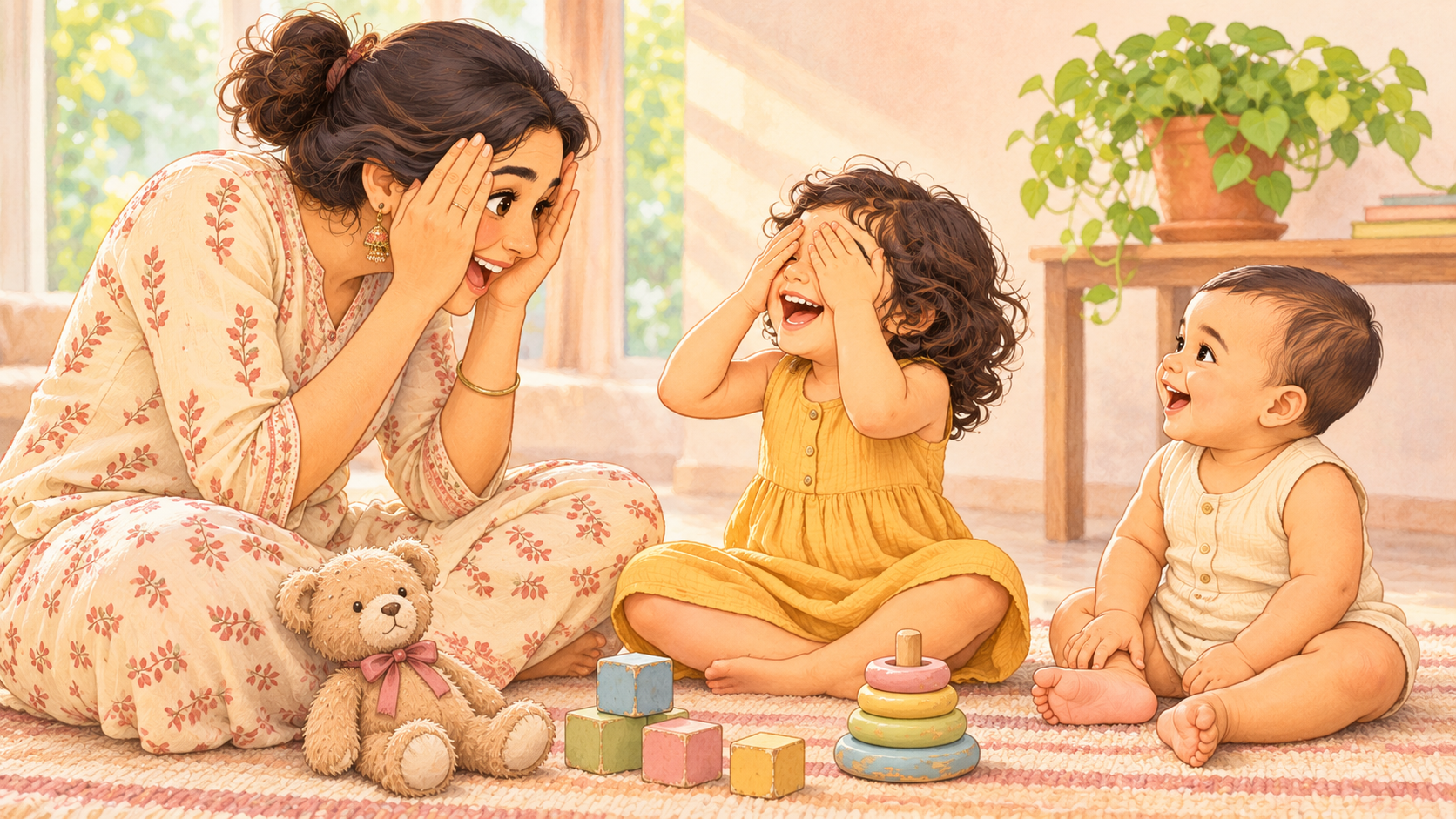
Quick answer: You can make Children’s Day special without buying anything. For babies and toddlers, the simplest celebration is your undivided attention. Try a favourite-song dance party, a living-room picnic, a short walk, a story you make up together, and one family photo to mark the day. Most children under three would pick these over another toy.
1. Start with the overflowing toy basket
You know the scene. The shelf is full, the basket is spilling over, and your toddler is happily banging a steel katori with a spoon. Or they’ve dropped everything to follow you around the kitchen.
Children’s Day (14 November in India, Jawaharlal Nehru’s birthday) often arrives with a quiet pressure to buy something. Parents in online communities regularly say they feel stuck between wanting the day to feel special and already having more toys than they can store. Many are looking for useful first-birthday gifts and non-toy gifts for two-year-olds.
Here’s the good news. Very young children don’t measure a celebration by what’s in the gift bag. They measure it by whether you were there, fully. Simple, everyday play is also what children need most. The American Academy of Pediatrics explains that unstructured play with caregivers supports development without needing special products.
Note for editor: Insert one line of IPF community poll data here, e.g. “We asked parents on the IPF community: [question]. [X]% said…” Use only real poll numbers.
2. “What can I give my child instead of another toy?”
Here is a quick-reference table of free and paid alternatives.
| Idea | Cost | Best for | Honest con |
|---|---|---|---|
| Park or terrace picnic | Free | 1–3 years | Check the weather and air quality first |
| Visit to a library or children’s book corner | Free to low | 1–3 years | Needs a short attention span, so keep it brief |
| Family photo book (printed album) | ₹300–800 | 6 months–3 years | Takes some prep time |
| Age-appropriate music or rhyme session | Free to ₹500 | 6 months–3 years | Can overwhelm a crowd-shy child |
| Board books in your home language | ₹100–400 | 6 months–3 years | Easy to end up with another pile |
| Preloved books or ride-ons | Low | 1–3 years | Check condition and safety |
| Practical gifts (sipper, bib set, sleepwear) | Varies | All ages | Only if the family genuinely needs them |
The rule of thumb: an experience or something needed beats an item that will sit in the basket.
3. Baby ideas vs toddler ideas, by age
Children enjoy different things at different stages. ZERO TO THREE’s activity guides are a good reference for age-based ideas.
| Age | Simple celebration ideas |
|---|---|
| Babies under 1 | Face-to-face songs and lullabies, peekaboo, looking at family photos, reading together, a gentle massage and a warm bath |
| Toddlers 1–2 years | Stacking large steel containers, dancing, simple hide-and-find games, a short outdoor adventure |
| Toddlers 2–3 years | A pretend café or chai stall, choosing the picnic spot, making up stories together |
4. “How do I celebrate Children’s Day at home?”
Pick one or two from this menu. You don’t need all of them.
- Living-room picnic: spread a dari or bedsheet, bring out a simple snack and eat on the floor.
- Favourite-song dance party: film songs, nursery rhymes, or the lullaby your child’s grandmother sings.
- Story corner: cushions, a dim light, and a story told in your home language.
- Pretend kitchen: a few steel katoris, a wooden spoon and a plate are all you need.
5. Make everyday participation part of the celebration
Toddlers love being “helpers.” Let them:
- Wash vegetables in a bowl of water (spinach, tomatoes, or bananas are easy to start with)
- Stir cold batter with your hand over theirs
- Sort clothes into piles, or match socks
Present these as shared moments rather than lessons. UNICEF’s baby and toddler activities show that daily routines can be rich learning time when parents talk, name things and let children join in.
Safety note: keep toddlers away from hot tawas, boiling pots, pressure cookers and sharp knives. Give them cold, safe jobs only.
6. “Does my toddler have too many toys?”
If your answer is “possibly,” try a gentle play-space refresh, not a big decluttering project.
- Put out a few familiar favourites.
- Pack away the others in a box for later (this is the idea behind toy rotation).
- Bring something back after a few weeks and watch your child greet it like new.
There is no magic number of toys, and the refresh shouldn’t be the main event of the day. If you want a deeper guide, see our post on toy rotation (internal link placeholder).
Got toys your child has outgrown? Instead of storing or discarding them, you can pass them on through the IPF marketplace, where listing is free.
7. Give grandparents and relatives alternatives
In many Indian families, gifting is an expression of love from dadi, nani, chachas, mamas and a long line of well-wishers. Saying “no gifts” can feel awkward, so offer alternatives instead.
Ideas to suggest:
- A recorded story or lullaby from a faraway grandparent (a voice note or video call works)
- A planned outing together, such as an afternoon at the park or a family lunch
- A needed item, like a pair of shoes, a sipper, or sleepwear
- A contribution towards a future experience or a savings gift
A line you can use:
“We’re keeping gifts small this year, but we’d love a special afternoon together.”
Share it kindly and early, a few days ahead, so relatives don’t feel dismissed. Most are happy to have a concrete suggestion.
8. Include a genuinely no-spend celebration
If you want ideas without another shopping list, here’s a full day that costs nothing:
- Favourite breakfast (idli, banana pancakes, or whatever your child loves)
- A neighbourhood walk to spot birds, dogs, scooters and flowers
- Songs after nap time
- An extra bedtime story
That is a complete, loving celebration.
9. Keep the celebration comfortable for little children
Plan around:
- Naps and meals. A tired, hungry toddler won’t enjoy any party.
- Noise and crowds. Loud gatherings can overwhelm young children.
- Air quality. In November, air quality in some north Indian cities can be poor. Check the AQI before outdoor plans and have an indoor backup.
- Their interests. Follow what your child is curious about right now.
A short, familiar activity can be the whole celebration.
10. End with a repeatable family ritual
Rituals give children a sense of “this is what our family does.”
- Take one family photo every Children’s Day.
- Write a short note about what your child loves right now (favourite word, song, food). Read it back in five years.
- Visit the same picnic spot or park every year.
Bonus ideas (11–15)
- Cook one simple dish together (a banana-oats pancake or fruit chaat) and let your toddler “serve” it.
- Make a tiny photo wall of your child’s year using clips and string.
- Make a sensory tray from things at home: dry rice, dal, or a bowl of water with a spoon (supervised, with no small choking hazards for under-threes).
- Do a video call with grandparents and let your child “show” them a favourite toy, book or dance.
- Read a book twice. Repetition is how toddlers learn and feel secure.
Non-toy gifts for different ages: a quick decision matrix
| If your child is… | And the family wants… | Consider… |
|---|---|---|
| Under 1 | Something lasting | A photo album, a board book in your home language, a soft blanket |
| 1–2 years | Something useful | Sturdy shoes, a sipper, a growth-chart wall hanging |
| 2–3 years | Something experiential | A trip to the zoo or science centre, a planned outing, a story time |
| Any age | Something free | Your time, a song, a walk |
For more gift ideas, see our guides to what to get a 1-year-old and best gifts for 2-year-olds (internal link placeholders).
Frequently asked questions
What are non-toy gifts for a one-year-old?
Non-toy gifts for a one-year-old include board books, a family photo album, sturdy first shoes, a feeding sipper or bib set, a cosy blanket, or a planned outing such as a park visit or picnic. If the family needs something specific, practical items are welcome too.
How can I celebrate Children’s Day with a baby?
With a baby, keep it simple and sensory. Sing lullabies, play peekaboo, look at family photos together, read a short board book, and give a warm bath and massage. Short, calm, face-to-face time is the best “celebration” for babies under one.
What can toddlers do at home without screens?
Toddlers can dance to songs, build with steel containers or soft blocks, play hide-and-find, help wash vegetables (cold, safe tasks only), have a pretend café, listen to stories, or play with water or dry rice under supervision. The Indian Academy of Pediatrics recommends avoiding screens for children under two, so these hands-on activities are a good alternative.
How do I tell relatives we don’t want more toys?
Be warm and specific. Share your wishes early and offer alternatives: “We’re keeping gifts small this year, but we’d love a special afternoon together.” Suggesting a needed item, a recorded story, or a joint outing gives relatives something concrete to do.
Is it okay if my child has nothing to “open” on Children’s Day?
Yes. Babies and toddlers don’t have expectations around gift-opening. A day of warm attention, familiar routines and one small special moment is more than enough.
When is Children’s Day in India?
Children’s Day in India is celebrated on 14 November, the birthday of Jawaharlal Nehru. Universal Children’s Day is observed on 20 November by the United Nations.
The takeaway
You don’t need to buy more to make Children’s Day special. Pick one or two ideas, keep it short, and let your child set the pace. A song, a walk, a story and a photo will matter far more than another item on the shelf.
Have toys your child has outgrown? Give them a second life on the IPF marketplace, where listing is free, buyers pay a small commission, payments are protected by in-app escrow, and doorstep pickup and drop is available. Preloved toys, books and baby gear find new homes, and your shelf gets lighter.