
Quick answer: Start your return-to-work preparation about four weeks ahead. Use week one to confirm the essentials (return date, work arrangements, childcare, backup support), week two to plan care and home routines, week three to practise a real morning, and week four to make the first days easier. You don’t need to feel completely ready. Preparation just makes the transition a little softer.
If you’re counting down the days to your return, you might be feeling several things at once: a bit of excitement, a lump in your throat when you look at your baby, a flicker of guilt, a surprising amount of relief, or all of it before breakfast. All of that is normal. There is no single right way to feel about going back to work, and you don’t have to settle on one feeling before you start getting ready.
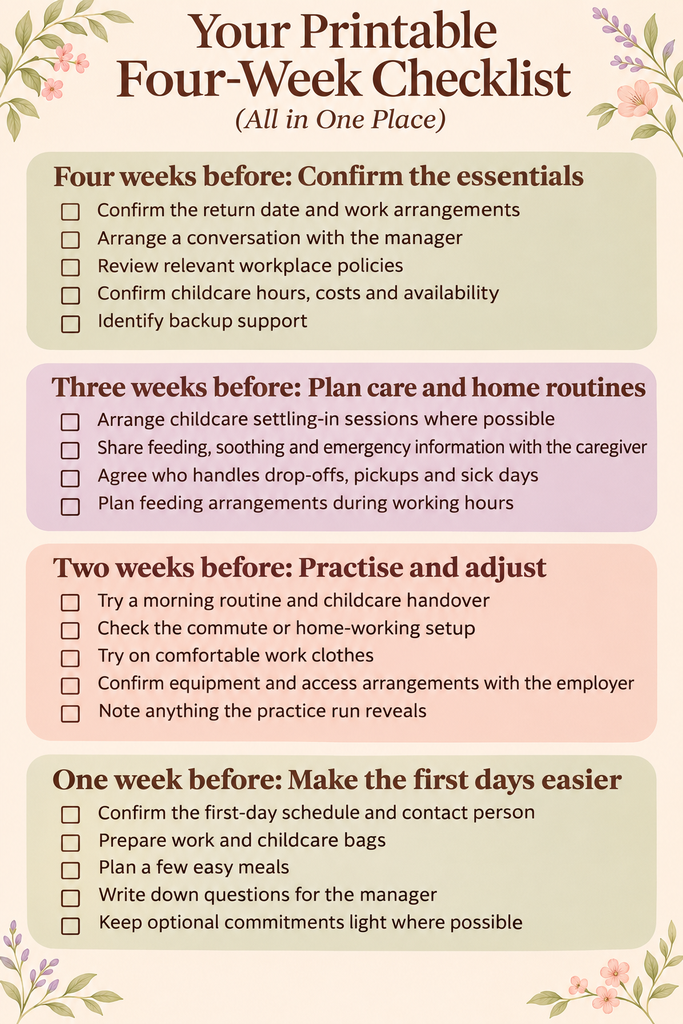
This guide walks you through a four-week countdown, with a checklist for each week that you can save or print. It is flexible on purpose. Your job, your family set-up, your childcare and the way you feed your baby will all look different from the next parent’s. Take what helps, skip what doesn’t.
Quick Overview: The Four-Week Plan
| When | Focus | Main tasks |
|---|---|---|
| 4 weeks before | Confirm the essentials | Return date, work arrangements, manager conversation, policies, childcare, backup support |
| 3 weeks before | Plan care and home routines | Settling-in sessions, caregiver briefing, who does drop-offs and pickups, feeding plan for work hours |
| 2 weeks before | Practise and adjust | Trial morning, commute or home-working check, comfortable work clothes, equipment and access |
| 1 week before | Make the first days easier | First-day schedule, bags, easy meals, questions for your manager, light commitments |
Start These Earlier If You Can
Four weeks is a countdown for final preparation, not the starting line. Some things take longer:
- Childcare searches. Good daycare places, trusted nannies and reliable helpers can take weeks or months to find, and waiting lists are common in bigger cities.
- Changes to working arrangements. If you want phased hours, a hybrid schedule or a work-from-home period, raise it early. Approval often goes through your manager, HR and sometimes a leadership sign-off.
- Formal notice and paperwork. Some employers expect written confirmation of your return date or a request for flexible working well in advance. Check your company policy.
If you’re reading this with less than four weeks to go, don’t panic. Do the most urgent items first (childcare and the manager conversation) and compress the rest.
Know your rights where you live. In India, the Maternity Benefit Act provides for paid maternity leave (26 weeks in the private sector under the 2017 amendment), and the amendment lets employers allow work from home after leave ends, by mutual agreement, where the nature of the work permits. Rules and eligibility vary by employer, so confirm the details with your HR team.
Week 4 (Four Weeks Before): Confirm the Essentials
This week is about turning “roughly sometime next month” into clear, confirmed details.
Return date and work arrangements. Confirm your exact first day, your working hours and whether you’ll be in the office, at home or a mix. If you’re planning a phased return (shorter days or fewer days at first), ask now rather than in week one.
A conversation with your manager. Book a short call or meeting before you return. Keep it practical: return date, working hours, your responsibilities, flexibility and how you’ll be supported in the first few weeks. See “Questions to Ask Your Manager” below.
Workplace policies. Read your company’s maternity, flexible working, work-from-home and leave policies. Look especially at policies on nursing breaks, crèche or daycare support and sick leave for a child.
Childcare. Confirm hours, costs, holidays, and what is and isn’t included. Check that the hours actually cover your working day plus the commute. Many parents are caught out by a pickup time that is 30 minutes earlier than their meetings end.
Backup support. Decide who steps in when plans change: a grandparent, a relative, a neighbour, a friend, a second caregiver. Ask them now, before you need them.
Week 4 Checklist
- ☐ Confirm return date and working arrangements in writing
- ☐ Arrange a conversation with my manager
- ☐ Review relevant workplace policies
- ☐ Confirm childcare hours, costs and availability
- ☐ Identify at least one backup person (ideally two)
Week 3 (Three Weeks Before): Plan Care and Home Routines
Settling-in sessions. If you can, arrange a few short visits with your baby and the caregiver, whether that’s a daycare, a nanny or a family member who will be taking over. Start with an hour or two, with you nearby, and build up. Babies often settle better when they’ve already met the people and the place. Some daycares offer trial days, so ask.
The caregiver briefing. Write down what the caregiver needs to know and keep a copy in the baby’s bag:
- Feeding routine and any milk or formula preparation steps
- Naps and soothing methods that work (and ones that don’t)
- Allergies, medicines and anything the doctor has advised
- Emergency contacts, the paediatrician’s number and the nearest hospital
- Who is allowed to pick the baby up
Handovers. Decide how you want drop-off and pickup to go. A calm, short goodbye usually works better than a long one, but do what feels right for you and your baby.
When someone is unwell. This is the one plan most families skip, and it is the one that causes the most stress. Agree in advance what happens if:
- Your baby is unwell and can’t go to daycare or be left with the usual caregiver
- Your caregiver is unwell or on leave
- You or your partner are unwell
Write down who takes the first call, who takes leave, who works from home and when you’d call the backup person.
Who does what at home. Talk through drop-offs, pickups, sick days, meals, laundry, grocery runs and appointments (vaccinations, check-ups). Planning is a job in itself, and it often falls on one person without anyone deciding that. Make it explicit and share it.
Feeding during working hours. See the optional section below.
Week 3 Checklist
- ☐ Arrange settling-in sessions with the caregiver where possible
- ☐ Share feeding, soothing and emergency information with the caregiver
- ☐ Agree who handles drop-offs, pickups and sick days
- ☐ Plan feeding arrangements for working hours
- ☐ Make a “if someone is unwell” plan
Feeding Arrangements
How you feed your baby is personal, and every approach in this section is a valid one. Skip whatever doesn’t apply to you.
If you’re breastfeeding and plan to express milk at work
- Ask your employer about suitable breaks, a private space (not a washroom) and somewhere to store milk, such as a fridge or a cooler bag with ice packs.
- Get familiar with your pump before you return. Practise assembling, cleaning and using it, and work out how long a session takes you.
- Start building a small stock of milk if it suits you, but you don’t need a freezer full of it.
- The Office on Women’s Health has practical guidance on breastfeeding and going back to work.
If you’re breastfeeding without expressing at work
Some parents breastfeed when they’re together (mornings, evenings, nights and weekends) and rely on formula or solids during the day. Your supply may take a few days to adjust. If you have questions or feel uncomfortable, a lactation consultant or your doctor can help.
If you’re formula feeding
Your main job is logistics: how many bottles, how formula is prepared and stored, and clear instructions for the caregiver. Practise a bottle handover before your first day.
If you’re combination feeding
You can mix breastfeeding, expressed milk and formula in whatever pattern works. Write down the pattern you want, and tell the caregiver which feed is which.
If your baby is on solids
Share the foods already introduced, any allergy watch-outs and how your baby likes meals served.
Two Workplace Scenarios: With and Without On-Site Support
Some offices have a crèche or daycare, a lactation room and flexible hours. Many don’t. Here is how to plan for each.
| Scenario A: Your office has a crèche or lactation room | Scenario B: Your office has neither | |
|---|---|---|
| Childcare | Ask about eligibility, age limits, costs, timings and whether there is a waiting list. Visit the crèche and meet the staff before your return. | Arrange childcare near home (or near work, if the commute is short). Consider a daycare, a trusted nanny or a family caregiver, and line up a backup. |
| Breaks | Confirm how many visits or breaks you’re allowed per day and how they are logged. | Ask your manager for fixed breaks you can rely on, and agree on how to cover meetings. |
| Expressing milk | Find out where the room is, whether it’s booked in advance and where milk is stored. | Ask for any private space, such as a vacant meeting room or a cabin. Bring an insulated bag with ice packs and a portable or hands-free pump if needed. |
| Nursing or care visits | If the crèche is on-site or nearby, plan feeds and visits around your meeting calendar. | If a visit isn’t possible, plan feeds around your commute and use expressed milk or formula in between. |
| If things don’t work out | Raise it with HR, since the facility is there to be used. | Ask for flexibility: later start, work-from-home days or a phased return. |
On the legal side, Indian law requires establishments with 50 or more employees to provide crèche facilities (or a shared one), and allows mothers a set number of visits to the crèche in a day. It also gives nursing mothers two nursing breaks a day until the child is 15 months old. How this works in practice depends on your employer, so check with HR. If your workplace doesn’t offer any of these, you can still ask for what would make things workable. Many managers say yes to reasonable, specific requests.
Week 2 (Two Weeks Before): Practise and Adjust
Think of this as a dress rehearsal. The aim isn’t to get it perfect. It’s to find the surprises before the first real morning.
Do a trial morning. Set your alarm, get yourself and your baby ready, do the childcare handover (or simulate it) and note how long everything actually takes. Most parents find they need more time than they’d planned.
Check the commute or home-working setup. If you’re commuting, do the route at the actual time you’d travel. If you’re working from home, check your desk, connectivity and where the baby will be during calls.
Try on work clothes. Your body may feel different. Pick something comfortable that you feel good in, and have a spare top in your bag for the first week.
Confirm equipment and access. Check with your employer that your laptop, login, email, building pass and any software are working.
Write down what the practice run reveals. Late for the handover? Forgot the bottle? Missing a charger? Jot it down and fix it this week.
Week 2 Checklist
- ☐ Try a full morning routine and childcare handover
- ☐ Check the commute or home-working setup
- ☐ Try on comfortable work clothes
- ☐ Confirm equipment and access arrangements with my employer
- ☐ Note anything the practice run reveals, and fix it
Week 1 (One Week Before): Make the First Days Easier
Confirm your first-day schedule. Know where to go, who to meet and who your point of contact is. Ask for a light first day if you can: meetings with your manager and team rather than a full workload.
Pack bags the night before. Two bags: your work bag (laptop, charger, ID, pump if needed, a snack, water) and your baby’s bag (spare clothes, nappies, feeds, comfort items, caregiver notes).
Plan a few easy meals. Cook and freeze a few dishes, or line up simple options like khichdi, dal-rice, upma or ready-to-cook basics, so that dinner isn’t a decision on busy evenings.
Write down your questions for your manager. Keep them in your phone.
Keep optional commitments light. Where you can, postpone social events, big errands and anything non-essential for the first couple of weeks.
Week 1 Checklist
- ☐ Confirm first-day schedule and contact person
- ☐ Prepare work and childcare bags
- ☐ Plan and prepare a few easy meals
- ☐ Write down questions for my manager
- ☐ Keep optional commitments light where possible
Questions to Ask Your Manager
You don’t need a formal agenda. A few focused questions are enough, and they also help you rebuild your professional confidence after time away:
- What are my first-week priorities?
- What has changed while I’ve been away? (team members, projects, tools, processes, clients)
- What flexibility is available? (hours, remote days, phased return, nursing breaks)
- When can we review how the return is going?
Asking for a short, focused update on team changes and immediate priorities means you can start with a clear picture instead of trying to catch up on everything at once.
Recovery and Energy: Plan for the Body You Have Now
By the time you return, you may still be recovering, whether from a birth, a surgery, broken sleep or all three. Your energy won’t be the same as it was before leave, and it may change from day to day.
When you plan your workload and your daily routine, look at what you need now:
- Build in time to eat properly and drink water.
- Be realistic about how much you can do in the first weeks.
- Ask whether you can ease in, with lighter days, fewer late meetings or a shorter first week.
- Protect your sleep where you can, even if that means asking others to take on night duties.
If you’re struggling with low mood, anxiety or exhaustion that isn’t lifting, please talk to your doctor. Postpartum mental health is part of your health, and it’s okay to ask for help.
Sharing Responsibilities at Home
Returning to work works best when the load at home is shared, and when it isn’t invisible. Sit down with your partner, family or whoever supports you, and decide together who handles:
- Drop-offs and pickups
- Sick days and doctor visits
- Meals and groceries
- Laundry and cleaning
- Vaccinations and appointments
- The planning behind all of it (remembering, booking, coordinating)
That last one matters. If one person is always the one who “remembers,” that’s a task too. A shared calendar or a simple weekly list can help. Plan to revisit it after the first week.
Review After the First Week
The first week is data, not a verdict. Set aside 20 to 30 minutes at the end of it, alone or with your partner, and ask:
- ☐ Childcare: Is the timing working? Is the baby settling? Is the handover smooth?
- ☐ Workload: Is it manageable? Do I need to talk to my manager?
- ☐ Feeding: Is the plan working for me and the baby? What should change?
- ☐ Home: Who’s doing what? Is it fair? What’s falling through the cracks?
- ☐ Me: How am I sleeping, eating and feeling?
Change one or two things, not everything.
Realistic Expectations: The First Few Weeks Are an Adjustment
Expect some wobbles. You might cry in the car, feel guilty in a meeting or feel oddly energised at lunch. The baby might protest at drop-off or sleep differently. Your confidence at work might come back faster or slower than you expected.
The first few weeks are a period of adjustment for everyone, and you’re allowed to adjust the plan as you learn. A “good” return isn’t one where everything goes smoothly. It’s one where you notice what isn’t working and change it.
Frequently Asked Questions
When should I start preparing to return to work after maternity leave?
Ideally, start thinking about it a couple of months before your leave ends, especially for childcare and flexible working requests. The four-week checklist covers the final stretch.
How do I know if my baby is ready for daycare?
There’s no fixed age or moment. Many babies settle well with gradual introductions, such as short visits, then longer stays. Watch how your baby responds and adjust. If you’re unsure, talk to your paediatrician.
What if my office doesn’t have a lactation room or crèche?
Ask for what would make things workable: a private room, regular breaks, a fridge for milk, flexible hours or a phased return. Many employers are willing to accommodate specific, reasonable requests. See the two scenarios above.
Can I return part-time or work from home?
In India, the law allows employers to let mothers work from home after maternity leave where the work permits, by mutual agreement. Whether part-time or hybrid options are available depends on your company, so ask early.
What if I’m not feeding my baby with breast milk?
Then skip the expressing parts. Everything else in this guide applies: caregiver briefing, settling-in, backup plans and shared responsibilities.
What if I feel guilty, sad or not excited about going back?
That’s very common, and so is feeling relieved or looking forward to it. You can feel more than one thing at once. If low mood or anxiety is affecting your daily life, please talk to your doctor.
What do I do when my baby or caregiver falls sick?
Have a plan before it happens: who takes the first call, who takes leave, who works from home and who is your backup. Write it down.
What if the plan doesn’t work?
Change it. The checklist is a starting point, and reviewing after week one is part of the plan.
Before You Go: Gear That Makes the Return Easier
Going back to work usually means a few extra bits of baby gear: a breast pump, bottles and a sterilizer, a diaper bag, a stroller or a travel cot for the caregiver’s home. You don’t have to buy everything new. On the IPF marketplace, parents in your community sell good-condition preloved baby products. Listing is free for sellers, buyers pay a small commission, payments are protected by in-app escrow, and doorstep pickup and drop is available. Browse feeding, travel and newborn essentials on ipfapp.in, and if you have gear you no longer need, list it for the next family.
A Final Word
You don’t have to feel completely ready, and you don’t need a perfect plan. Use the steps that help, skip the ones that don’t, and adjust as you learn what works for you and your family. A little preparation goes a long way, and so does a little kindness toward yourself.
This article is for general information and isn’t legal, employment or medical advice. Check your employment contract and company policies, and talk to your doctor or lactation consultant for personal health or feeding questions.