If you’re expecting your first baby, you’ve heard every version of this conversation:
“Babies don’t need much.” “The real expenses start once school begins.” “You’ll just figure it out as you go.”
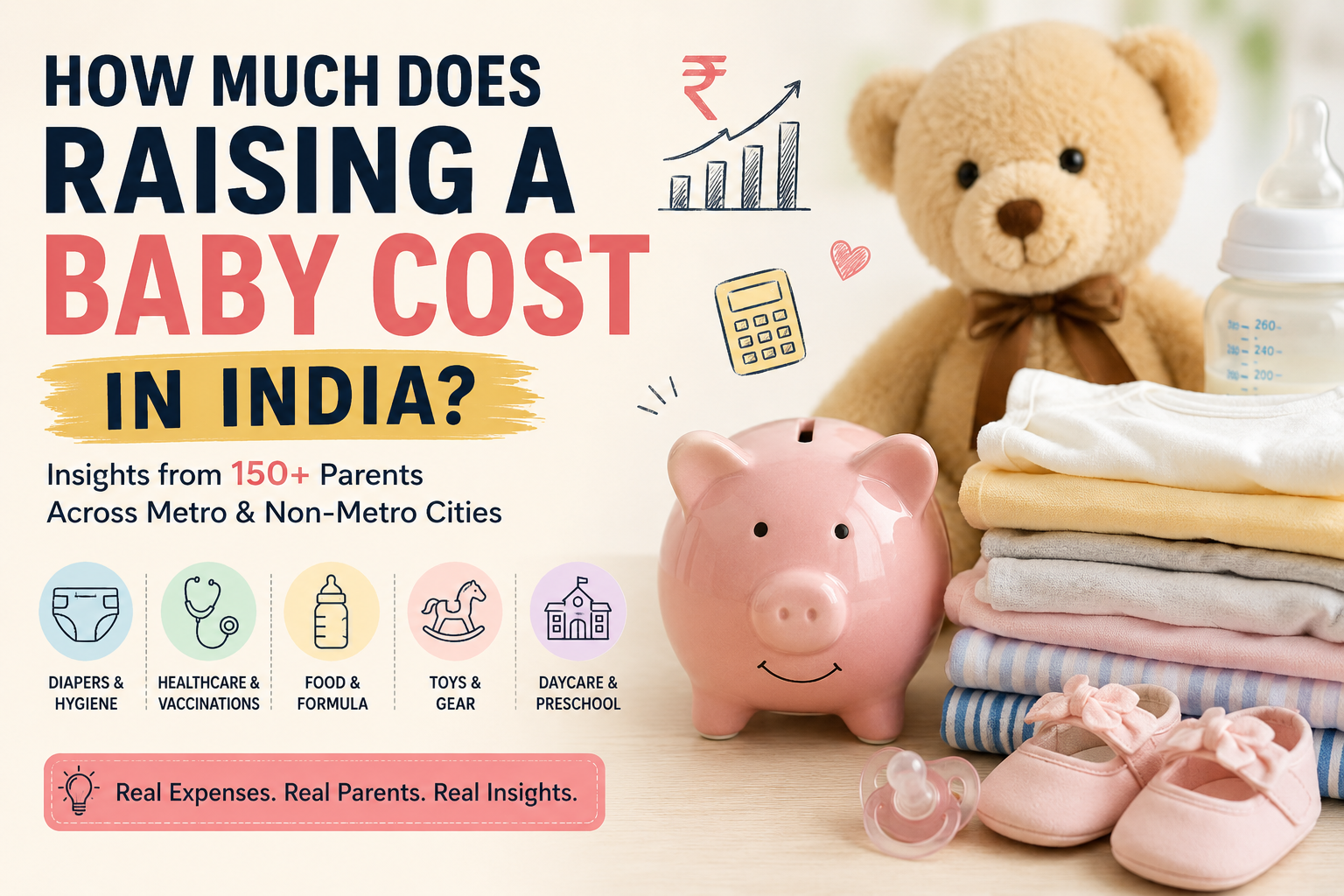
None of that tells you what to actually put in your budget. So instead of guessing, we asked. IPF surveyed 157 parents across India — from Mumbai, Bengaluru, and Chennai to Coimbatore, Chhindwara, and Visakhapatnam — about what they spend every month, where the money goes, and what caught them off guard. Here’s what the data shows.
Quick answer: how much does a baby cost per month in India?
Most Indian parents spend ₹10,000–₹20,000 a month on a child, though a similar share get by on under ₹10,000. Metro-city parents spend noticeably more than parents in smaller towns, mainly because of daycare, private healthcare, and preschool fees. Diapers and hygiene products (76% of parents), healthcare and vaccinations (52%), and food or formula (47%) are the three costs almost every parent named as a top-three monthly expense.
The average monthly cost of raising a baby in India
There isn’t one “correct” number — spend varies by city, the child’s age, and how much family or paid help a household has. Here’s the full spread from our survey of 157 parents:
| Monthly spend | % of parents |
|---|---|
| Under ₹10,000 | 38% |
| ₹10,000–₹20,000 | 31% |
| ₹20,000–₹30,000 | 14% |
| ₹30,000–₹50,000 | 11% |
| Over ₹50,000 | 6% |
Takeaway: roughly 7 in 10 families spend under ₹20,000 a month on their child. Spending above ₹30,000 is real but is the exception, not the norm — usually driven by daycare, a full-time nanny, or private-hospital healthcare rather than by the baby itself.
Metro vs non-metro: does your city change the number?
Yes, clearly. We grouped responses into metro cities (Mumbai, Delhi NCR, Bengaluru, Chennai, Hyderabad, Pune, Kolkata, Ahmedabad) and everywhere else.
| Monthly spend | Metro cities | Non-metro cities |
|---|---|---|
| Under ₹10,000 | 36% | 45% |
| ₹10,000–₹20,000 | 31% | 34% |
| ₹20,000–₹30,000 | 14% | 11% |
| ₹30,000+ | 20% | 10% |
Parents in non-metro cities were nearly twice as likely to stay under ₹10,000 a month. In metros, the same budget gets eaten up faster by:
- Daycare and preschool fees that can rival rent
- Private-hospital vaccinations, especially “painless” ones parents specifically called out as costly
- Nannies and domestic help, which several parents said was harder to arrange affordably than to budget for
- Higher prices on everyday baby gear and branded products
Where does the money actually go?
We asked parents to pick their top three monthly expense categories. Across 157 responses, the same few categories came up again and again:
| Category | Share of parents who named it in their top 3 |
|---|---|
| Diapers and hygiene | 76% |
| Healthcare and vaccinations | 52% |
| Food and formula | 47% |
| Clothing | 35% |
| Daycare or preschool | 34% |
| Nanny or household help | 24% |
| Toys and gear | 24% |
| Activities and classes | 8% |
Diapers and hygiene: the most universal cost
No other category came close. Diapers showed up as a top-three expense for three out of four parents. The comment we heard most often, in one form or another: it’s a small purchase every time, but the monthly total adds up fast — one parent put it simply as “diapers are too expensive.”
Healthcare and vaccinations: the least predictable cost
Vaccinations, and specifically private-hospital and “painless” vaccinations, were the single most-mentioned surprise in the entire survey. Parents also flagged unplanned hospital visits and, in one case, a 40-day NICU stay, as costs no one had budgeted for.
Food and formula: the one that scales fast
For parents relying on formula, this category jumps quickly. One parent estimated formula alone can run close to ₹10,000 a month if breastfeeding isn’t an option. Others pointed to the rising cost of fruit, berries, and other “healthy” snacks as their child grew.
Daycare, preschool, and nannies: the metro divide
This is where city matters most. Parents in Mumbai, Bengaluru, and the NCR repeatedly said childcare rivalled their rent. One Noida parent noted school fees now run above ₹50,000. Several parents also flagged a cost that isn’t always top of mind before the baby arrives: reliable nannies are expensive and hard to find — one parent summed it up as harder to find than “a good husband.”
The hidden cost nobody warns you about
When we asked what surprised parents most, the answers weren’t about one big purchase. They were about volume:
- “Everything keeps adding up.”
- “The costs are never ending.”
- “It’s all the small, everyday expenses.”
That’s the real shape of baby expenses in India. It’s rarely one large bill. It’s diapers this week, a vaccination next month, bigger clothes in ninety days, a new car seat, another toy, a preschool admission fee — and the monthly number quietly climbs.
The money spent on things barely used
This is the part most first-time parents underestimate. We asked how much parents think they’ve spent on baby items that barely got used.
| Amount spent on barely-used items | % of parents |
|---|---|
| Under ₹5,000 | 44% |
| ₹5,000–₹15,000 | 33% |
| ₹15,000–₹30,000 | 6% |
| Over ₹30,000 | 8% |
| Never thought about it | 9% |
That’s roughly 1 in 7 parents who’ve sunk over ₹15,000 into items their child barely touched. The usual suspects: cribs, playpens, walkers, baby swings, and toys. As one parent put it, “we buy playpens and cribs, but babies just want to be around us.” Another: “kids don’t even play with the toys.”
How spending changes as your child grows
The survey captured children from newborn to 5+ years, and the pattern is consistent: the categories shift, but the “constant small expenses” feeling doesn’t go away.
- 0–1 year: Diapers, formula, and vaccinations dominate. This is also when parents reported the highest one-off “barely used” spend — on cribs, playpens, and gear bought before they knew what their baby would actually want.
- 1–3 years: Diapers and healthcare are still there, but clothing, toys, and daycare start competing for the budget. Nanny and household help become a bigger line item as parents return to work.
- 3–5+ years: Preschool and school fees, activities, and extracurriculars take over as the largest expense. One parent summarised the full arc well: diapers and formula dominated the first year, vaccinations followed, and now it’s “school and school supplies plus extracurriculars.”
So, how much should you actually budget?
Based on the full spread of responses, here’s a realistic range by lifestyle, not a single number:
Budget-friendly: ₹8,000–₹15,000/month Breastfeeding, strong family support, minimal paid daycare, and deliberate spending — largely on diapers, basic healthcare, and food.
Average urban family: ₹15,000–₹30,000/month Diapers, vaccinations, clothing, food, toys, and occasional paid childcare.
Premium metro lifestyle: ₹30,000–₹50,000+/month Full-time nanny, daycare or preschool, private healthcare, branded products, and structured activities. A handful of parents in our survey reported spending over ₹50,000 a month at this end.
FAQs
How much does it cost to raise a baby in India per month? Based on a survey of 157 Indian parents, most spend between ₹10,000 and ₹20,000 a month, with 38% spending under ₹10,000. Costs rise with city, childcare choices, and whether formula or paid help is involved.
Is raising a baby more expensive in metro cities? Yes. 20% of metro parents surveyed spend over ₹30,000 a month, compared to 10% of non-metro parents. Daycare, private healthcare, and nannies are the main drivers of the gap.
What is the biggest monthly baby expense in India? Diapers and hygiene products were named a top-three expense by 76% of parents surveyed, ahead of healthcare and vaccinations (52%) and food or formula (47%).
Is it worth buying pre-loved baby products? 65% of parents surveyed have already bought or sold pre-loved baby items, and a further 25% are open to it. The main barriers are trust and item condition, not the concept itself — which is why verified sellers, quality checks, and easy pickup matter more than price alone.
How much do parents waste on baby items they barely use? Nearly 1 in 7 surveyed parents estimate they’ve spent over ₹15,000 on items their baby rarely used — most commonly cribs, playpens, walkers, and toys.
The bottom line
Raising a child in India is getting more expensive, and it’s rarely one big bill — it’s the steady accumulation of small, recurring ones. The parents in our survey who felt most in control weren’t the ones spending the least; they were the ones who planned for the predictable costs (diapers, vaccinations, food) and stayed deliberate about the one-off purchases that tend to go unused.
That’s also where buying and selling pre-loved makes the most practical difference — not as a compromise, but because babies genuinely outgrow gear faster than they wear it out. If you’re weighing a crib, stroller, or playpen right now, it’s worth checking IPF’s pre-loved marketplace first: listing is free for sellers, buyers pay a small commission instead of full retail, and every transaction is protected by in-app escrow with doorstep pickup and drop — so you get the savings without the usual resale-app trust problem.
Survey methodology: Responses were collected from 157 parents across India, covering metro and non-metro cities, with children ranging from newborns to over five years old. Figures represent self-reported monthly expenses and spending patterns shared by participating parents on the IPF community.