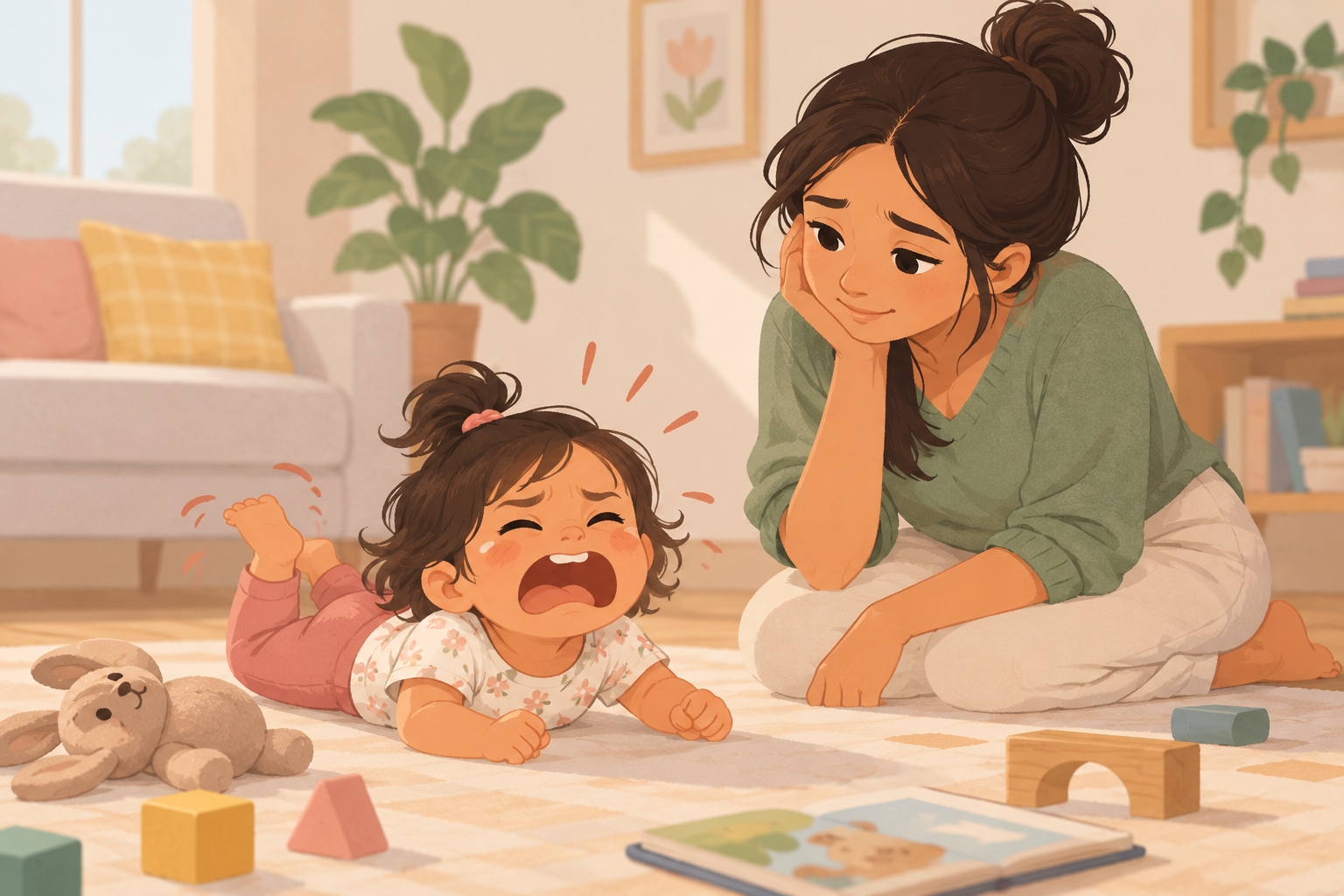
Quick answer: A tantrum isn’t something you need to “win.” It’s a moment when your toddler is overwhelmed by a big feeling and doesn’t yet have the skills to manage it. The most effective response is to stay calm, briefly name the emotion, hold the boundary on behaviour (not the feeling), and wait it out — then talk about it once your child is calm, not during the meltdown.
Toddlers can go from happily playing to screaming or throwing themselves on the floor in seconds, often over something that looks tiny to us — the wrong-coloured cup, one more biscuit, leaving the park. For a toddler, that “tiny” disappointment can feel enormous, because they’re still learning how to handle emotions they don’t yet have words for.
Why Do Toddlers Have Tantrums?
Tantrums are considered a normal part of development between roughly 1 and 5 years, most common in the toddler years. Paediatric guidance points to a few overlapping reasons:
- Limited language and self-expression — toddlers often feel frustration or anger before they have the words to explain what’s wrong.
- Still-developing self-regulation — the ability to manage reactions and calm down starts forming from around 12 months and keeps maturing well into the preschool years, which is why meltdowns fade gradually rather than stopping overnight.
- Low frustration threshold from tiredness, hunger, illness, or overstimulation — these physical states make any setback feel bigger.
- Trying to influence what happens around them — young children are also testing how their behaviour affects the people around them.
Tantrums typically occur once a day on average and last around 5–10 minutes at this age, though this varies widely by child and temperament.
The Three Stages of a Tantrum (and What to Do in Each)
Understanding that a tantrum usually escalates in stages makes it easier to respond calmly instead of reactively.
| Stage | What It Looks Like | What Helps |
|---|---|---|
| 1. Build-up | Whining, crying, yelling | Move the child to a calmer spot; offer a distraction or a simple alternative (“You can’t have the biscuit, but you can pick an apple or a banana”) |
| 2. Peak | Falling to the ground, stamping, screaming, rolling | Ensure the space is safe; stay close but don’t over-engage with the attention-seeking behaviour; avoid reasoning mid-meltdown |
| 3. Wind-down | Whimpering, seeking comfort | Physically comfort and soothe; offer a calming activity; reconnect once they’re calm |
What to Do in the Moment: 7 Things That Actually Help
1. Name the feeling instead of dismissing it
Instead of “Stop crying, it’s not a big deal,” try: “You really wanted to keep playing. You’re upset that playtime is over.” You don’t have to agree with the reason for the tantrum to acknowledge that the feeling is real.
2. Accept the feeling, limit the behaviour
All feelings are okay; not all actions are. “You’re really angry. It’s okay to be angry. I won’t let you hit me.” This keeps you empathetic without giving in to unsafe behaviour.
3. State the boundary without a “but”
“I know you’re upset, but we have to go” can make the first half feel like it didn’t count. Try separating the two: “You really wanted to stay at the park. You’re disappointed. It’s time to go home now.”
4. Match the emotion before expecting calm
A toddler mid-meltdown usually isn’t ready for a cheerful “It’s okay, don’t cry!” Matching the seriousness — “Ughhh, you REALLY wanted that!” — can help them feel understood enough to start calming down.
5. Say less, stay close
Firing questions (“Why are you crying? What happened?”) can overwhelm an already-overwhelmed toddler. Staying nearby with simple acknowledgements (“I’m here,” “That was hard”) communicates that you’re listening without adding pressure.
6. Keep your own response calm and consistent
Staying calm gives your child a model to copy — shouting back tends to escalate things. Responding the same way every time (rather than sometimes giving in) also teaches your toddler that a tantrum won’t get them what they want, which reduces how often they happen over time.
7. Know when to physically intervene
If a tantrum turns dangerous — hitting, running into traffic, self-harm — calmly hold or move your child to safety first. Explanations and boundary-setting can wait until everyone is safe and calm.
Toddlers vs. Older Children: The Response Is Different
| Toddlers (1–3 years) | Older Children (4+ years) | |
|---|---|---|
| Why it happens | Can’t yet communicate needs/emotions in words | Haven’t yet learned safer ways to manage big feelings |
| Best response | “Time-in” — stay close, offer comfort, acknowledge feelings without reasoning through it | A calming-down sequence: identify the emotion, name it, pause, support them through it, then address what triggered it |
| Consequences | Not developmentally useful mid-tantrum | Can start understanding natural consequences (e.g., “If you scream, your friends may not want to play”) once calm |
Preventing Tantrums: What Reduces the Frequency
You can’t eliminate tantrums, but a few habits make them less likely:
- Keep routines predictable — regular sleep and meal times mean fewer meltdowns from hunger or overtiredness.
- Plan around known triggers — run errands after a nap or a meal, not before.
- Offer small choices — “Red shirt or blue shirt?” gives toddlers a sense of control over things that don’t matter much.
- Use positive phrasing — “Use your inside voice” lands better than a string of “don’t”s.
- Narrate and praise calm moments — “You built that tower again and didn’t get upset when it fell — how did that feel?” helps toddlers notice their own progress.
- Be consistent — same response to the same behaviour, every time, in every setting.
Give the Feeling Somewhere to Go
For toddlers who don’t yet have the words for their frustration, offer another outlet:
- Scribbling hard on paper or tearing scrap paper
- Stomping feet or squeezing a cushion
- Drawing an “angry face” together
- A short, imaginative acknowledgment of the wish itself — “I wish we could stay at the park all day too!” — without promising to grant it
This isn’t distraction from the emotion; it’s a safer way to express it.
What to Avoid During a Tantrum
- Long explanations or lessons — save teaching about sharing, patience, or consequences for after your child has calmed down.
- Laughing at the tantrum — even if it feels comical, laughing can either reward the behaviour with attention or make your child feel mocked.
- Giving in inconsistently — occasionally caving “just this once” undoes the consistency that helps tantrums fade over time.
- Matching their volume with anger — a shouting match tends to escalate rather than de-escalate.
When to Talk to a Paediatrician
Most tantrums are a normal, if exhausting, part of growing up, and they typically become less frequent by around age 3½. Consider checking in with your child’s paediatrician if you notice:
- Tantrums getting worse rather than better after age 4
- Your child holding their breath to the point of fainting during outbursts
- Frequent self-harm or harm to others during meltdowns
- Tantrums that are more frequent or intense than typical, and are disrupting daily routines
If you’re in India and need to talk to someone urgently about a child’s wellbeing, CHILDLINE 1098 is a free, 24/7 helpline.
Quick-Reference Decision Table
| Situation | Do This First |
|---|---|
| Meltdown just starting (whining, crying) | Move location if possible; offer a simple choice or distraction |
| Full-blown tantrum (screaming, falling, kicking) | Keep the space safe; stay nearby; don’t try to reason mid-outburst |
| Tantrum turning aggressive or unsafe | Calmly hold or remove your child from the situation; safety first |
| Tantrum winding down | Comfort, soothe, and reconnect |
| Child is calm afterward | Briefly talk about what happened and what they could try next time |
| Tantrum in a public place | Stay consistent — don’t give in just to stop the scene; a “paradoxical instruction” (“you can keep yelling, it’s a big park”) sometimes helps |
FAQs
At what age do toddler tantrums usually start and stop? Tantrums are most common between about 1.5 and 5 years of age, peak in the toddler years, and typically become less frequent by around age 3½ as self-regulation skills develop.
How long does a normal tantrum last? Most tantrums last around 5–10 minutes, though this varies by child, trigger, and how tired or hungry they are.
Should I ignore a toddler’s tantrum completely? Not completely — ignore the attention-seeking behaviour (like escalated screaming for effect) while staying physically nearby, keeping your child safe, and calmly acknowledging their feelings once they’re ready.
Is it okay to give in sometimes just to stop a public tantrum? Occasional giving-in can actually make tantrums more frequent, because it teaches a child that a big enough reaction gets results. Consistency, even when it’s uncomfortable in public, helps more in the long run.
Do tantrums mean my toddler is being manipulative? No. Young children don’t have tantrums deliberately to upset or embarrass a parent — they genuinely don’t yet have the skills to manage the emotion they’re feeling.
When should I worry about tantrums and see a doctor? Talk to your paediatrician if tantrums are getting worse after age 4, involve breath-holding to the point of fainting, cause frequent self-harm or harm to others, or are far more frequent/intense than typical for your child’s age.
What’s the difference between a tantrum and an autism meltdown? A meltdown in an autistic child happens when they feel completely overwhelmed and lose control of their behaviour or ability to calm themselves, and can look like yelling, rocking, or withdrawing — it’s a response to sensory or emotional overload rather than a bid for something specific.
The Bigger Picture
Calming down is a skill your toddler is still learning — how to tolerate disappointment, wait, communicate wants, and recover after being overwhelmed. They won’t master it after one conversation, or even ten. The goal isn’t a perfectly calm toddler; it’s a child who’s slowly getting better at handling big feelings, with you as a steady, safe presence alongside them.
A simple reminder for the next meltdown: Name the feeling → Accept the emotion → Limit unsafe behaviour → Say less → Stay close → Give them a safe way to express it.
On IPF, parents in the community regularly swap notes on what actually works for their toddler’s tantrums — sensory toys, calming corners, and books on big feelings included. If you’re building a “calm-down kit” at home, check the IPF marketplace for preloved sensory toys, quiet-corner cushions, and toddler emotion books — listed free by other parents, with in-app escrow protection and doorstep pickup/drop so you’re not paying full price to figure out what your toddler actually responds to.