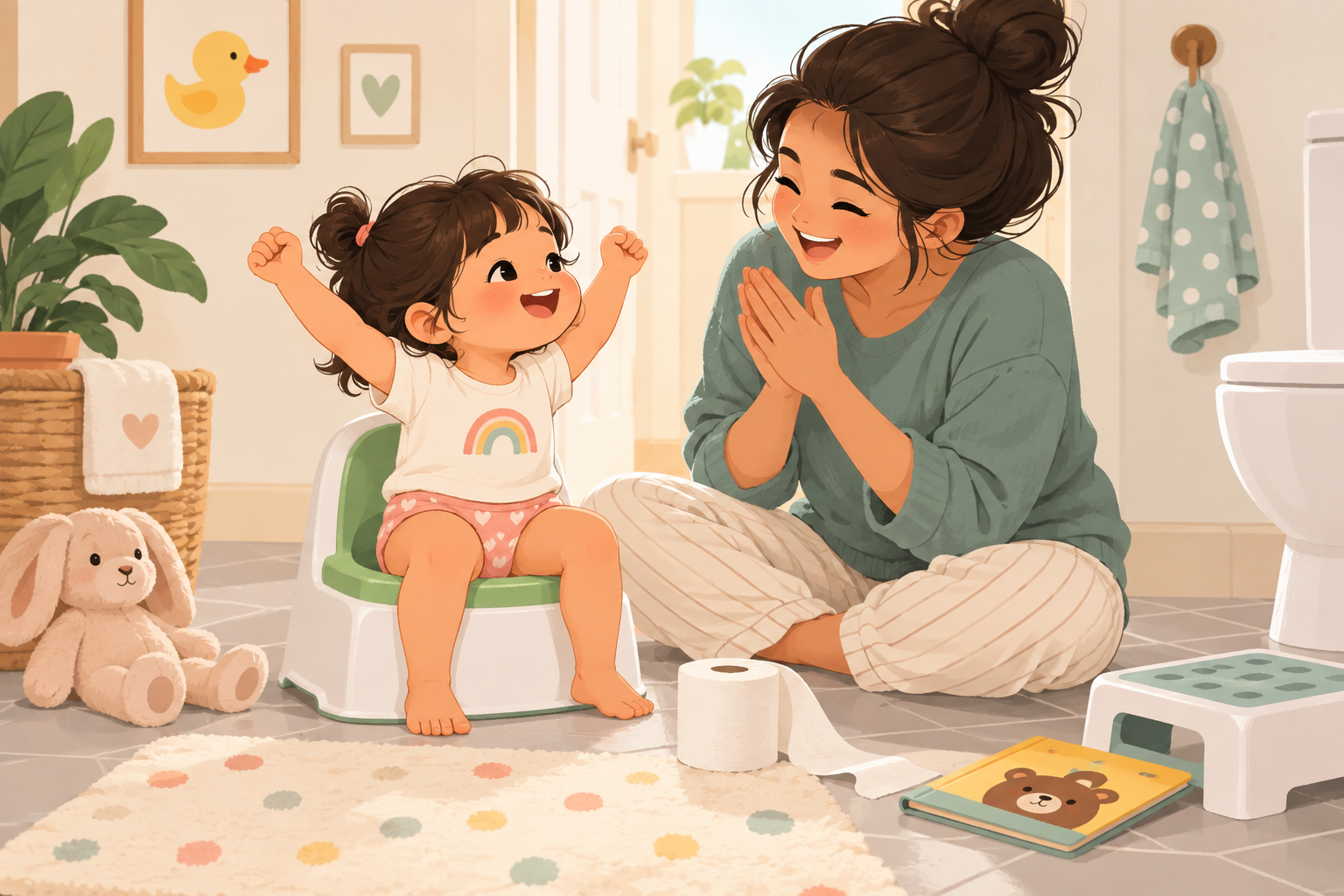
“Will my toddler really be potty trained in three days?” — it’s one of the most-searched parenting questions in India, and also one of the most misleading. The honest answer: three days is usually enough to introduce the routine, not to guarantee a diaper-free toddler. Some kids get there fast. Many don’t, and that’s completely normal.
This guide walks you through what the method actually involves, how to tell if your toddler is ready, a day-by-day plan, and — just as importantly — what to do if Day 3 comes and goes without much progress.
What Is the 3-Day Potty Training Method?
It’s a focused, intensive approach where a parent (or two, taking shifts) clears three consecutive days to help a toddler learn to recognise the urge to pee or poop and use the potty. It typically involves:
- Staying home, away from a rigid schedule
- Keeping the child in light clothing or without bottoms, for easy access
- Offering the potty every 20–30 minutes, or at natural transition points
- Lots of fluids, lots of praise, and a calm response to accidents
The method traces back to a 1974 book on rapid toilet training and has been popularised since by various “potty training queens” and parenting authors. The goal isn’t perfection by Day 3 — it’s building familiarity and muscle memory. Full independence, especially staying dry through naps and nights, usually comes later.
Quick Comparison: What Different Sources Actually Promise
| Source/Approach | What “3 days” really means | Realistic timeline |
|---|---|---|
| Classic 3-day method | Diapers off, focused potty routine begins | Basic daytime awareness in 3 days; full independence in 2–6 weeks |
| Gentle/child-led approach | No fixed timeline; child decides when ready | Can take weeks to months, often smoother |
| Community experience (real parents, various forums) | Day 1 often goes well; Day 2–3 can regress | Wide range — some 3 days, many 2–8 weeks |
There’s no method that works identically for every child — readiness matters more than the calendar.
Is Your Child Ready?
Readiness doesn’t mean ticking every box below — but the more that apply, the smoother this will go:
- Can walk to and sit on a potty or toilet seat
- Communicates the need to pee/poop — verbally or through gestures
- Can pull pants up/down with some help
- Stays dry for longer stretches (1.5–2 hours)
- Shows curiosity about the toilet or imitates you
- Follows simple instructions
- Seems uncomfortable in a wet or dirty diaper
Most children show these signs somewhere between 18 months and 3 years — there’s genuinely no universal “right age.”
Before the 3 Days: Set Yourself Up
- Pick a stretch with no travel, no guests, and no illness in the house
- Buy a potty seat/chair and several sets of easy-to-remove clothing (elastic waist, no buttons or zips)
- Keep 15–20 pairs of underwear or padded/reusable training pants on hand — there will be accidents, and you don’t want to run out
- Introduce the potty a few days ahead so it isn’t a stranger on Day 1
- Designate a “safe zone” — a room with a washable floor, not your good carpet
- Talk to your child beforehand in simple language: “From tomorrow, pee and poop go in the potty.”
- Loop in grandparents, nanny, or daycare so the routine stays consistent once the three days are over
Day-by-Day Plan
Day 1 — Introduce the Routine
- Start the moment your child wakes up; some families make a small ceremony of “putting the diapers away”
- Offer the potty every 20–30 minutes rather than asking “do you need to go?” (the answer is almost always no)
- Keep fluids up so there are more chances to catch a success
- Celebrate every attempt, successful or not; stay neutral, not alarmed, about accidents
- Expect this to be tiring and slow — that’s normal, not a sign you’re doing it wrong
Day 2 — Build the Connection
- Continue the same rhythm; if Day 1 went reasonably well, you can introduce simple pants over bare bottom or training pants
- Start nudging your toddler to tell you when they need to go, instead of you initiating every trip
- Try a short window of play away from the potty, just to build a little independence
- If Day 1 was mostly accidents, it’s fine to stay in the same “naked/no-bottoms” phase for longer
Day 3 — Practise Independence
- Encourage your child to recognise the urge and walk to the potty on their own
- Practise pulling clothing up and down with minimal help
- If things are going reasonably well, attempt a short outing — a walk around the block is a good first test
- Keep reminding gently rather than asking or forcing
What About Poop?
This deserves its own section because poop training genuinely takes longer than pee training for most toddlers.
- It’s common for a child to pee in the potty confidently but ask for a diaper specifically to poop
- The sensation is new and can feel scary — some toddlers describe it as something “falling out” of them
- Encourage (don’t force) sitting after meals, when the body’s natural urge to pass stool is strongest
- Keep stools soft with enough fluids and fibre in the diet
- If your child is consistently withholding stool, straining, or seems to be in pain, speak to your pediatrician — this can point to constipation, which makes training much harder
Handling Accidents
- Accidents are part of the process, even on a day that started well
- Skip “it’s okay” (it can send the message that it doesn’t matter) — instead try something like: “Oops, your pee came out. Next time, it goes in the potty.”
- Never scold, shame, or compare your toddler to a sibling or another child
- Let your toddler help with simple cleanup if they’re up for it — it reinforces the routine without punishment
- Use each accident as information: were they distracted, did they just drink a lot, or did they simply not notice the urge in time?
Common Mistakes That Make It Harder
- Starting before your child shows real signs of readiness
- Expecting zero accidents by the end of Day 3
- Asking “do you need to go?” on repeat (it becomes background noise, or a power struggle)
- Forcing your child to sit on the potty for long stretches
- Switching strategies every few hours instead of staying consistent
- Reverting to a diaper the moment things get hard — this undoes the “diapers are gone” message
- Not telling your daycare or nanny, so the routine breaks the moment you’re not around
What If the 3 Days Don’t Work?
This is the part most “3-day” guides gloss over, and it’s worth saying plainly: if your toddler isn’t fully trained by Day 3, nothing has gone wrong. For a meaningful number of families, three days is a starting point, not a deadline. Some children need several more weeks; a few need a couple of months.
If you’re hitting strong resistance — tears, withholding, refusal to even sit — it’s completely fine to pause for a few weeks and try again later. Toilet learning tends to progress in stages regardless of the method: sitting on the potty → recognising the urge → using it consistently → initiating independently, without reminders.
Night-Time Training Is a Separate Milestone
Daytime dryness and night-time dryness don’t happen on the same timeline, and one doesn’t guarantee the other. Bladder control at night often develops months after daytime training, sometimes not until a child is 4 or older. Keep night diapers or a mattress protector on hand for as long as needed, and avoid waking your child up specifically to pee unless your pediatrician has suggested it for a reason.
Quick Reference: The 3-Day Goal by Day
| Day | Main focus |
|---|---|
| Day 1 | Introduce the potty, offer it frequently, watch for cues |
| Day 2 | Build the routine, encourage communication, try light clothing |
| Day 3 | Practise independence, attempt a short outing |
When to Check In With a Pediatrician
- Your child seems to be in pain while urinating or passing stool
- There’s blood in the urine or stool
- Persistent withholding or constipation
- Significant fear or distress around the toilet that doesn’t ease with a break
FAQs
Is 3-day potty training realistic? For some toddlers, yes — basic potty awareness can build in three focused days. Full independence, especially overnight, usually takes longer, and that’s normal.
What’s the best age to start potty training? There’s no fixed age. Most children show readiness signs somewhere between 18 months and 3 years; readiness matters more than age.
Why does my toddler pee in the potty but refuse to poop there? This is extremely common. Poop training often lags behind pee training by weeks. Stay patient, encourage (don’t force) sitting after meals, and speak to a pediatrician if there’s consistent withholding.
Should I use pull-ups during 3-day training? Most versions of the method recommend regular underwear or training pants over pull-ups during the day, since pull-ups can feel too similar to a diaper for a toddler to notice wetness.
What if my toddler isn’t trained after 3 days? That’s common, not a failure. Take a short break if there’s strong resistance, then continue the same routine without pressure. Many children need a few extra weeks.
Marketplace CTA
Potty training usually means a fast rotation through training pants, potty seats, and washable mats — gear your toddler outgrows within weeks. On IPF, you can pick up gently-used potty training essentials at a fraction of retail price, with escrow protection and doorstep pickup/drop, or list your own once your toddler’s moved on to the next stage. [Browse potty training & toddler essentials on IPF →]