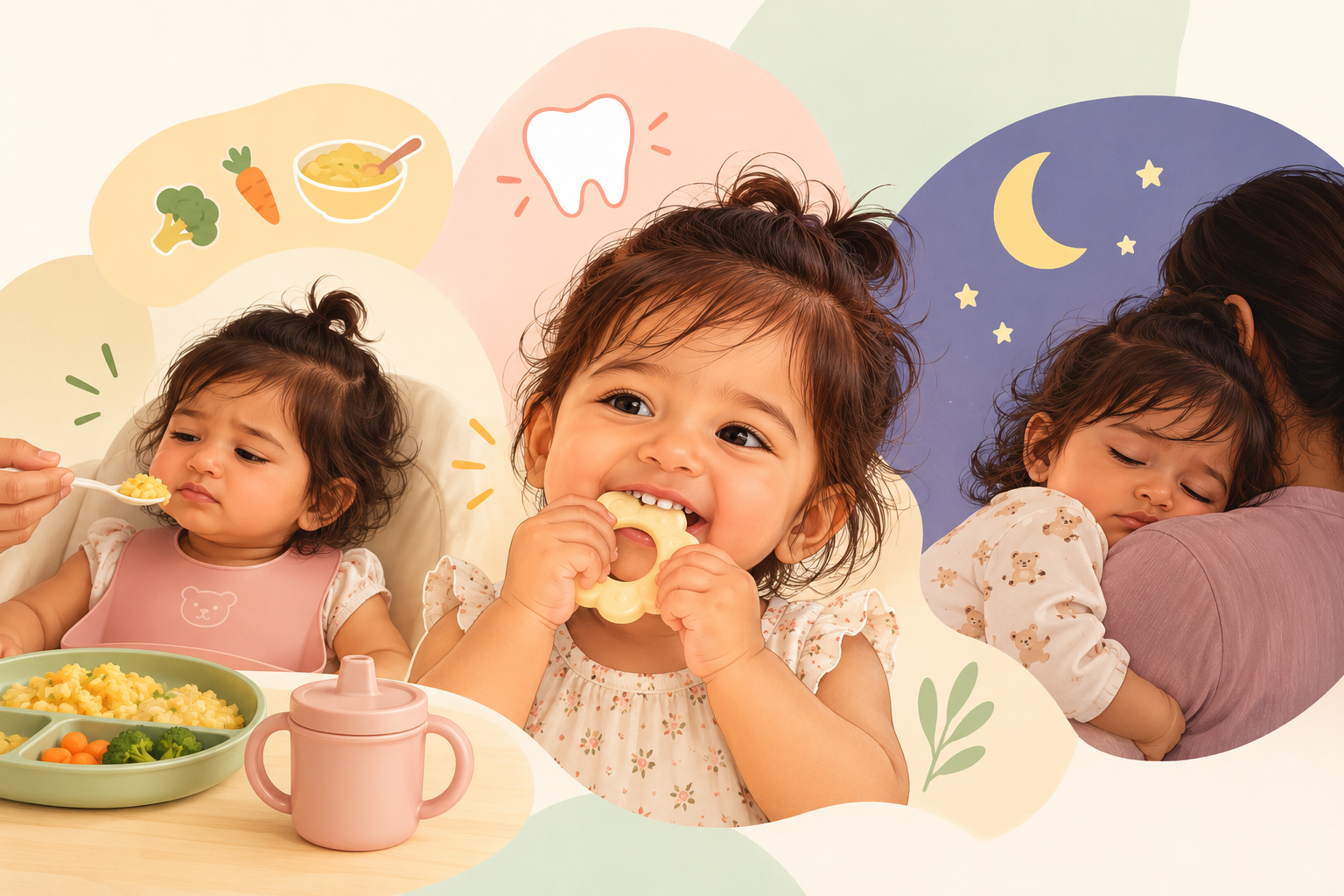
Quick answer: Most babies start teething between 4 and 7 months. Typical signs are swollen gums, drooling, fussiness, chewing on everything and disturbed sleep. Cold, solid teethers and gentle gum massage are the safest ways to soothe a baby. A real fever (38°C / 100.4°F or higher), vomiting, diarrhoea or a baby who refuses all feeds is not normal teething. Call your pediatrician.
Your baby was happy yesterday. Today there’s drool everywhere, a cranky little person, and a 2 a.m. wake-up that no amount of rocking fixes. In the IPF community, “is this teething?” is one of the most common questions parents ask.
This guide covers what’s normal, what helps, what to avoid, and when to stop blaming teething.
When do babies start teething?
Most babies get their first tooth between 4 and 7 months (AAP). Others may begin later, even around 12–14 months, and that can still be normal. Different bodies put the range at 6–10 months, so you’ll see small variations between sources.
Teething isn’t one event. Teeth arrive in batches over about three years, and most children have all 20 baby teeth by age 3.
Baby teething chart (approximate)
| Teeth | Usually appear |
|---|---|
| Bottom front two (lower central incisors) | 6–10 months |
| Top front two (upper central incisors) | 8–12 months |
| Teeth on either side of the top front two | 9–13 months |
| Teeth on either side of the bottom front two | 10–16 months |
| First molars (back teeth) | 13–19 months |
Timing is a guide, not a deadline. Family history plays a big role. If there’s no tooth by around 12–14 months, mention it to your pediatrician or pediatric dentist.
Why does teething hurt?
Before a tooth shows up, the gum over it has already been broken down by hormones. That makes the gum swollen and tender, and the swelling is what causes the discomfort. The pain tends to be worst just around the time the tooth breaks through, then eases.
Symptoms cluster in a short window. A prospective study found they tend to occur in roughly an 8-day window: the 4 days before the tooth comes through, the day it erupts, and the 3 days after. A baby who has been “teething” for six weeks straight probably has something else going on, or is simply getting teeth one after another.
Signs your baby is teething
Every baby is different. Some barely notice, and others howl. Common signs:
- Swollen, tender gums
- Drooling more than usual
- Fussiness and crying
- Chewing or gnawing on hands, toys, anything
- Rubbing the cheek or tugging the ear
- A slight rise in temperature (below 100.4°F)
- Changes in eating or sleeping
Teething rash
The red rash on the chin, cheeks or chest isn’t caused by the tooth. It comes from drool irritating the skin. Keep a soft cloth handy to dab (not rub) the drool away, and wipe the face gently through the day.
Teething or something else?
Teething is uncomfortable, but it doesn’t usually make babies sick. Sources vary a little on low-grade temperatures, but they agree on the line that matters: a true fever isn’t teething.
| Likely teething | Not teething: call your pediatrician |
|---|---|
| Swollen, sore gums | Fever of 38°C / 100.4°F or higher |
| Drooling, chewing, fussiness | Vomiting or diarrhoea |
| Slightly raised temperature (under 100.4°F) | Rash on the body |
| Cheek rubbing, ear pulling | Cough and congestion |
| Restless sleep | Fluid from the ear, severe pain |
| Eating a bit less | Bleeding gums, pus or facial swelling |
Ear infection looks similar. Both teething and ear infections can cause fussiness, ear-pulling and changes in eating or sleeping. But high fever, severe pain, fluid from the ear, balance problems or trouble responding to sound point to an ear infection, not teething.
How to soothe a teething baby safely
Do these
- Massage the gums. Wash your hands, then gently rub the sore area with a clean finger or a damp gauze pad. Many babies find the pressure comforting.
- Offer something cold and solid. A solid rubber or silicone teether, a clean wet washcloth knotted and chilled, or a chilled (not frozen-hard) pacifier.
- Keep teethers clean. Wash teethers and cloths after each use.
- Always supervise anything your baby chews.
- For older babies on solids, cold foods like chilled curd or applesauce can feel good on sore gums.
A note on freezing: advice differs here. Some sources suggest freezing a washcloth for about 30 minutes, while others caution that rock-hard frozen items can hurt a baby’s gums. The safer middle path is to refrigerate teethers and cloths rather than freezing them solid.
Avoid these
- Teething necklaces and amber beads. They are a strangulation and choking risk, and the pain-relief claims aren’t proven.
- Liquid-filled teethers. They can leak or break.
- Hard plastic teethers and anything that could break into pieces.
- Gels with benzocaine. The FDA says they shouldn’t be used in children under 2. Gums rubbed with gel also wash clean quickly, and the gel can numb the back of the throat and make swallowing harder.
- Homeopathic teething tablets. Investigators found inconsistent amounts of belladonna, a toxic substance, in some of them.
- Sugary or salty “teething biscuits.” They add little nutrition and chunks can break off and choke.
- Honey on the gums. A traditional home remedy, but honey isn’t safe for babies under 12 months.
What about pain relief medicine?
If your baby is clearly in pain, ask your pediatrician about paracetamol (or ibuprofen, which is generally for babies 6 months and older). The dose depends on your baby’s weight, so never guess a dose or give medicine on a relative’s or friend’s advice.
Teething and sleep
Parents often notice that a baby who is fine all day falls apart at night. The AAP notes that teething pain can keep babies awake, and that’s real. There’s also no good evidence that babies sleep more while teething. If yours is sleeping more, look for another cause, like a growth spurt.
At night there’s less to distract your baby, so sore gums are all they notice. Tiredness from poor daytime naps makes it worse.
Teething or sleep regression?
If it’s teething, you’ll usually see other signs of discomfort during the day too, such as drooling, chewing and fussiness. Teething discomfort can also wake a baby 10–20 minutes into sleep, while a regression tends to cause waking between sleep cycles.
5 ways to get through the night
- Massage gums before the bedtime feed. Easier feeding means less waking from hunger.
- Keep teethers ready. Chill a few clean washcloths or teethers in the fridge before bed.
- Bring bedtime earlier if naps were short. 15–30 minutes earlier can prevent overtiredness.
- Offer extra cuddles but keep your routine. Bath, feed, story or song, same order. Big changes, like lots of new rocking or feeding to sleep, can create new sleep habits that outlast the teething.
- Ask your doctor about pain relief if your baby is obviously uncomfortable at bedtime.
A few rough nights during teething don’t “ruin” your baby’s sleep routine. Return to normal once the tooth is through.
Teething and eating: what if my baby refuses food?
A baby with sore gums may eat less for a few days, chew less enthusiastically, or prefer softer foods. That’s common and usually short-lived.
- Keep offering, don’t force. Offer food, encourage, and let your baby decide how much. Pressure turns meals into battles.
- Don’t stop solids. Soft, age-appropriate textures like khichdi, dalia, mashed vegetables, soft idli and mashed fruit are easier on sore gums.
- Try cold. Chilled curd or applesauce can soothe while feeding.
- Milk still matters. Breastfeeding often comforts a teething baby, though some babies find sucking painful and feed less. If your baby nips while nursing, try dipping your finger in cold water and massaging their gums first.
- Offer water in a sippy cup only if your baby is 6–9 months or older.
- Don’t panic over one bad meal. One difficult meal doesn’t make a “bad eater.”
Red flags: refusing both milk and food, signs of dehydration (fewer wet nappies, dry mouth), weight loss, or feeding trouble lasting more than a few days. Call your pediatrician. That’s not simply teething.
Caring for new teeth
Good dental habits start before the first tooth:
- Wipe gums with a clean damp cloth or gauze at least once a day before teeth appear, then twice a day once teeth come in.
- Don’t let a baby fall asleep with a bottle. Milk pooling in the mouth can lead to tooth decay.
- Start brushing as soon as the first tooth appears. Use a soft baby toothbrush and a rice-grain-sized smear of fluoride toothpaste.
- First dental visit: when the first tooth appears, or by the first birthday.
- If your baby falls and hits their mouth, call your dentist promptly.
Checkout our guide on baby Teething here.
When to call the doctor
- Fever of 38°C (100.4°F) or higher
- Vomiting, diarrhoea, or a rash on the body
- Cough or congestion
- Pus, facial swelling or bleeding gums
- Severe or constant crying, or a baby who is unusually sleepy or limp
- Refusing both milk and solids, or signs of dehydration
- No tooth by around 12–14 months
If you’ve used a homeopathic teething tablet and see seizures, trouble breathing, lethargy, flushed skin or unusual agitation, seek emergency care immediately.
FAQs
When do babies start teething?
Most start between 4 and 7 months, but anywhere from about 4 to 14 months can be normal.
How long does teething last?
Each tooth causes a few days of symptoms. The whole process runs until about age 3, with most children having all 20 teeth by then.
Does teething cause fever?
A slight rise in temperature may happen, but a true fever (38°C / 100.4°F or higher) is not a normal teething sign. Call your pediatrician.
Does teething cause diarrhoea?
No. Extra drool and chewing everything can loosen stools slightly, but significant diarrhoea usually points to infection.
Why is teething worse at night?
Fewer distractions, tiredness and being away from parents make discomfort feel bigger at night.
Can teething make my baby sleep more?
There’s no scientific proof of that. Teething more often means worse sleep.
What is the best teether?
A solid, one-piece rubber or silicone teether that you chill in the fridge. Avoid liquid-filled or hard plastic ones.
Are teething gels safe?
Not generally recommended. They wash away quickly, can numb the throat, and benzocaine gels shouldn’t be used under 2 years. Check with your pediatrician first.
Do I need to stop solids during teething?
No. Keep offering soft, familiar foods without forcing.
Save-this checklist
Soothe → Chill → Comfort → Keep routine → Watch for red flags → Call the doctor if unsure
Teething stage means a lot of gear, and a lot of it is outgrown fast. Browse the IPF marketplace for preloved baby sleep essentials, sleep sacks, white noise machines, feeding gear and high chairs from parents who’ve been through it. Sellers list for free, buyers pay a small commission, and escrow protection plus doorstep pickup and drop make it easy.