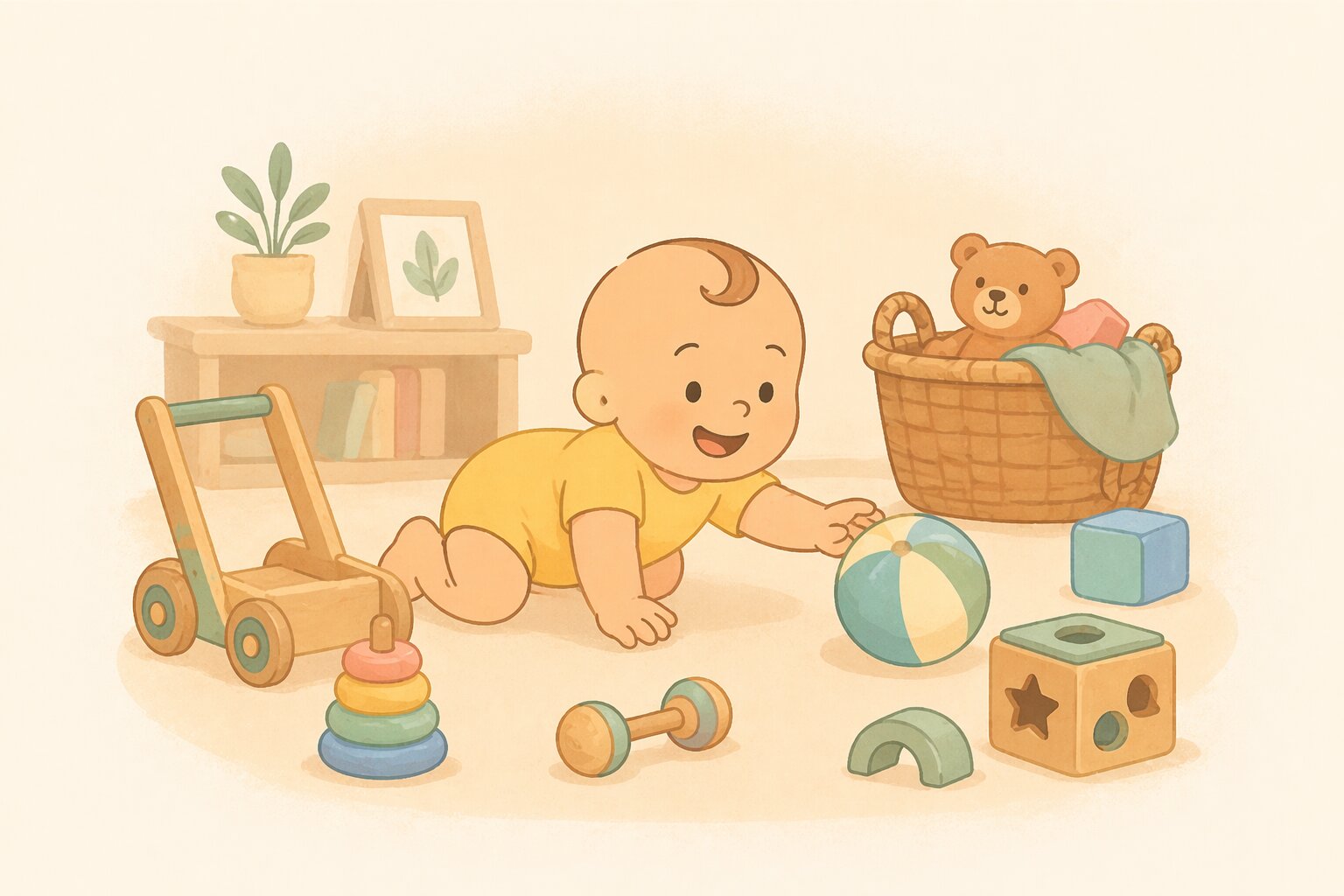
You don’t need a house full of toys to support your baby’s growth.
A few well-chosen motor skill toys for babies can do far more than dozens of random ones. The best toys for baby development are simple, purposeful, and designed to encourage movement, from reaching and rolling to crawling and exploring. This age-wise guide covers developmental toys for infants (0-12 months) that truly support how babies grow; without adding clutter.
Why Movement & Exploration Matter
Play begins at birth. Long before your baby says a word or takes a step, they are learning through every touch, sound, and movement. As parents, our job isn’t to buy more — it’s to choose better.
Developmental toys aren’t about pushing milestones. They support your baby’s rapidly growing brain and body at their own pace:
- Sensory learning : one contrast, one texture, one sound at a time. Simplicity beats stimulation overload.
- Motor skills : gross motor comes first (rolling, reaching, floor time), followed by fine motor (grasping, stacking, transferring).
- Early cognition : babies learn cause-and-effect, then object permanence, then imitation — in that order.
Research also shows that when toys pile up, babies actually engage less. Fewer, well-chosen toys lead to longer, deeper play. Less clutter, more curiosity.
Age-Wise Breakdown
Best Toys for 0-4 Month Old Babies
At this stage, your baby is discovering their own hands and adjusting to the world outside the womb. Keep it simple.
- Simple rattles and teething toys
- High-contrast black-and-white books or cards
- Infant play gym with hanging elements
Best toys for 4-6 Month old Babies
Your baby is now reaching, grasping, and putting everything in their mouth. Toys should be easy to hold and safe to chew.
- Easy-grip rattles and grasping toys
- Soft sensory balls
- One-piece teethers (avoid anything with detachable parts)
- Cloth books with crinkle paper and an unbreakable mirror
- Nesting cups for early banging and in/out exploration
Best toys for 6-9 Month old babies
Sitting up, passing objects hand to hand, and babbling — this is a big leap. Introduce cause-and-effect play.
- Soft sensory balls and easy-grip rattles (they still love these!)
- Cloth books with textures and mirrors
- Nesting and stacking cups
- Simple push-along toys on flat surfaces
Best toys for 9 -12 Month old babies
Crawling, pulling to stand, and figuring out how things work. This is when exploration really takes off.
- Posting toys and simple shape sorters with large pieces (sit and do it together first)
- Open/close containers — lids, flaps, simple latches
- Chunky board books with thick pages
- Simple instruments — shakers, small drums — at a modest volume
- Push/pull toys with a wide, stable base
- Washable pretend-play items with no small parts
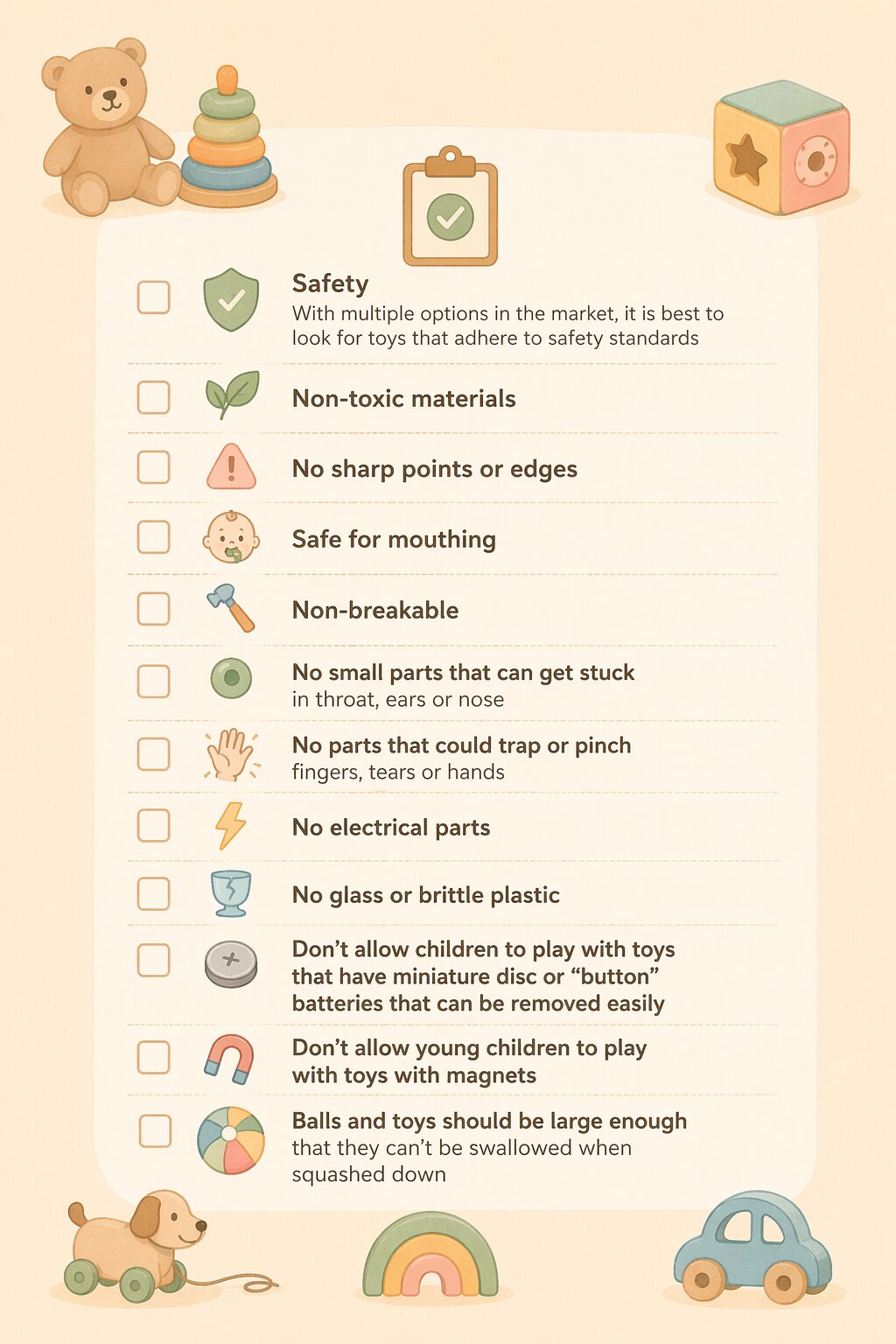
Safety — What to Check Before You Buy
With hundreds of options available, it’s easy to feel overwhelmed. Here’s a quick checklist to run through before any purchase:
- Non-toxic, BPA-free materials
- No sharp points or edges
- Safe for mouthing
- Unbreakable or shatter-resistant
- No small parts that can be swallowed or lodged in ears or nose
- No pinch points that can trap little fingers or toes
- No electrical components for babies under 12 months
- No glass or brittle plastic
- Avoid toys with button/disc batteries that a child can remove easily
- Avoid strong magnets in toys for children under 3
- Balls and round toys should be large enough that they cannot compress small enough to swallow
A Final Word
The best toy you own is already free. Your attention, your voice, your face — nothing on the market comes close. Toys are tools, not teachers. Choose ones that are open-ended, minimally stimulating, and easy to rotate in and out.
Buy less. Play more. Choose Better. Your child will thank you for the space.
👉 Explore the right toys for your baby on IPF app.
👉Explore the Best toys Recommended by IPF Parenting Community Here.