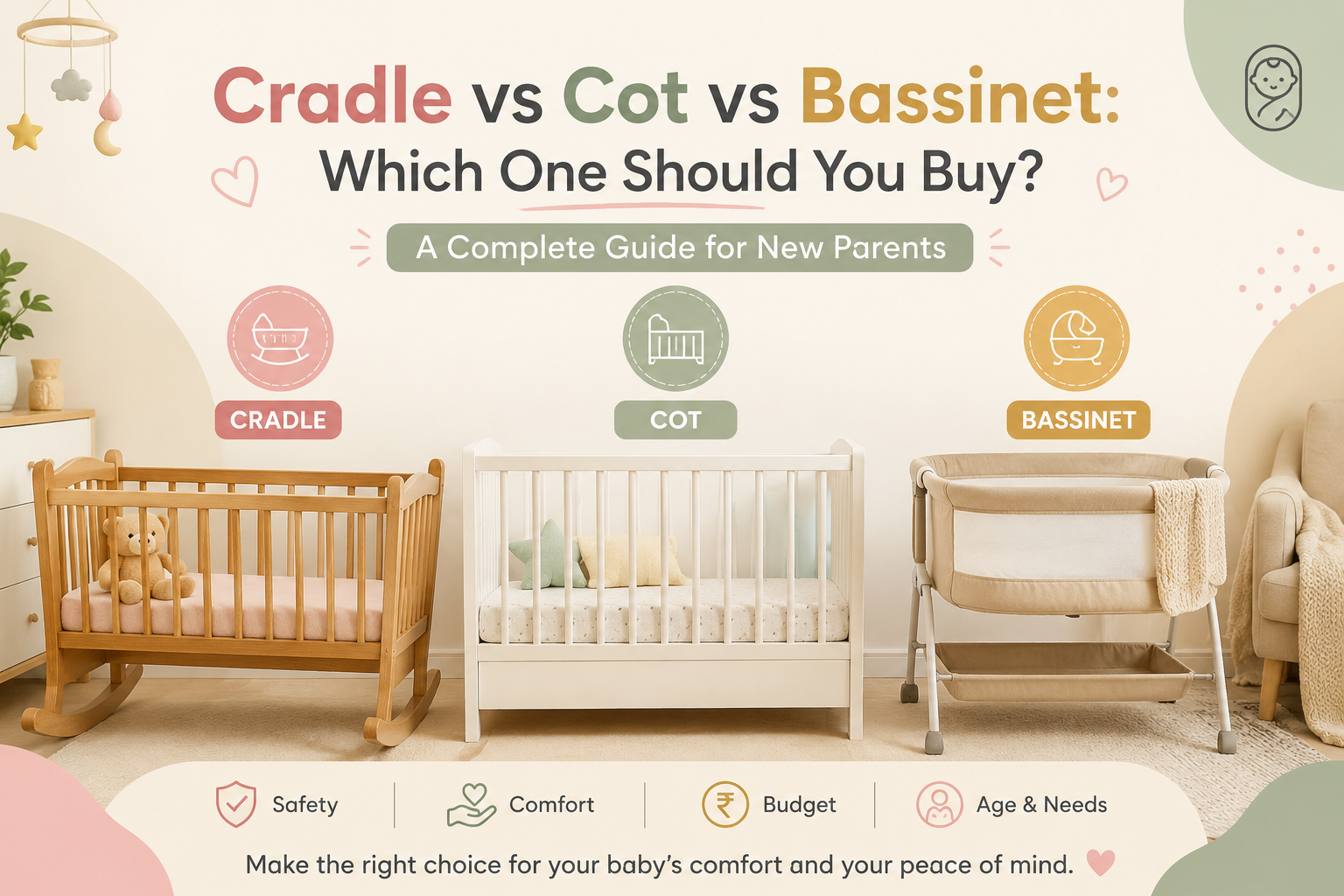
Somewhere between the baby shower and the hospital bag, every new parent hits the same wall: do we need a cradle, a cot, or a bassinet — and why do people keep using these words like they mean the same thing?
They don’t. And the difference isn’t just vocabulary — it affects your baby’s safety, your sleep, your budget, and how much space you’re giving up in the bedroom for the next two years. Here’s the no-fluff comparison.
Quick Comparison Table
| Cradle | Bassinet | Cot | |
|---|---|---|---|
| Best for age | 0–5 months | 0–5/6 months | 0–3 years |
| Movement | Gentle rock/swing | Usually stationary, some swivel | Stationary |
| Portability | Moderate | High (many have wheels) | Low |
| Typical price (India) | ₹3,000–₹12,000 | ₹4,000–₹15,000 | ₹8,000–₹30,000+ |
| Space needed | Small | Smallest | Largest |
| Lifespan of use | Short (grows out fast) | Short | Long (with conversion kits, years) |
| Room-sharing friendly | Yes | Yes, designed for it | Bulkier, but doable |
| Resale value | Moderate | High (short usage window = good condition) | Moderate to high if well-maintained |
What Each One Actually Is
Cradle: A small, often wooden or wicker bed suspended or mounted so it can be rocked. In many Indian households this is the traditional jhula or paalna — sometimes cloth-hammock style, sometimes a wooden swinging frame passed down through generations. It’s designed purely to soothe a newborn to sleep with motion.
Bassinet: A compact, freestanding basket-style bed, usually on a stand or with wheels, meant for a baby’s first few months. Bassinets are built to sit right next to your bed, which is exactly what the American Academy of Pediatrics recommends — keeping baby’s sleep space in the same room as yours, close to your bed, for at least the first six months. Most modern bassinets don’t rock as dramatically as a cradle; some have gentle vibration or sway settings instead.
Cot (Crib): The bigger, sturdier bed most babies eventually move into — with fixed rails, a full-size mattress, and enough depth to be used safely as your baby starts sitting, pulling up, and eventually walking. It’s the only one of the three built to last well beyond infancy.
Community Insight: What Indian Parents Actually Chose
We ran a quick poll with the IPF parent community on Instagram asking what they bought first for their newborn. Here’s the pattern that came through:
- A large share of parents went cradle-first, often because a family member already had one, or it was gifted — a very common route in Indian households where the paalna is practically a rite of passage.
- Parents who prioritized room-sharing and easy nighttime feeds leaned toward a bassinet, especially in nuclear family setups or apartments with limited bedroom space.
- Very few families bought a cot as their first purchase — most transitioned into one around 4–6 months, once the baby outgrew the cradle or bassinet.
The consistent theme: your first bed is rarely your last. Most babies cycle through two of these three within the first year, which is exactly why the resale/preloved market for cradles and bassinets is so active — they’re used hard for a short window and then no longer needed.
Honest Pros and Cons
Cradle
Pros: The rocking motion genuinely soothes newborns, it’s compact, and if it’s a hand-me-down, it costs nothing upfront. Deep cultural and emotional value for many families.
Cons: Many traditional cradles — especially cloth-hammock jhulas — don’t meet modern firm, flat sleep-surface safety standards. Motion needs to be used only to help baby fall asleep, not as a place they sleep unsupervised through the night. Outgrown quickly.
Bassinet
Pros: Purpose-built for safe newborn sleep, easy to move room to room, ideal for co-sleeping-adjacent room sharing without bed-sharing. Many modern bassinets meet current safety certifications with breathable mesh sides and a firm, non-inclined mattress.
Cons: Short usable window (most babies outgrow one by 5–6 months or once they can push up on hands and knees), so it’s a second purchase you’ll need to replace soon.
Cot
Pros: One-time investment that lasts years, especially with height-adjustable bases and toddler-conversion rails. Sturdiest option once baby is mobile.
Cons: Bulky for a newborn’s early months, higher upfront cost, harder to keep bedside in a smaller room.
What Actually Matters for Safety
Regardless of which one you pick, current pediatric guidance is consistent on the essentials: babies should sleep on their backs, on a firm and flat surface, in a crib or bassinet free of loose bedding, pillows, toys, or bumpers. A crib, bassinet, portable crib, or play yard should conform to recognised consumer safety standards, and sleep surfaces inclined more than 10 degrees from horizontal are considered unsafe. Sitting devices like car seats, strollers, swings, and slings are not recommended for routine sleep, particularly for infants younger than 4 months.
This is the one place we’d nudge caution on heirloom cradles and jhulas: they’re emotionally significant, but check that the mattress is firm (not a soft cloth sling), the frame is stable, and there’s no gap where a baby’s head or limb could get trapped, before using it for actual sleep and not just supervised soothing.
Decision Matrix: Which One Fits Your Situation?
| Your situation | Best pick |
|---|---|
| Tight budget, family already owns a traditional cradle | Cradle (check it against modern safety basics first) |
| Small apartment, want baby right next to your bed | Bassinet |
| Planning to travel or shift rooms often in the first few months | Bassinet (most are lightweight/wheeled) |
| Want to buy once and skip a second purchase later | Cot with a bassinet attachment or co-sleeper mode, if budget allows |
| Baby is already past 5–6 months or pushing up/rolling | Cot — cradles and bassinets are no longer safe once baby is mobile |
| Prioritizing resale value if you’re not having more kids soon | Bassinet (shortest, gentlest usage window keeps it in the best condition) |
FAQs
Is a cradle safe for a newborn to sleep in all night? Only if it meets firm, flat, safety-standard criteria. Traditional rocking cradles are best used for soothing and supervised naps; for unsupervised night sleep, a certified bassinet or cot with a firm mattress is the safer choice.
At what age should a baby move from a bassinet to a cot? Most babies transition around 4–6 months, or earlier if they can push up on their hands and knees, roll over unassisted, or reach the bassinet’s weight/height limit — whichever comes first.
Can I skip the bassinet and go straight to a cot? Yes, some families do, especially if space and budget favor a single purchase. The trade-off is that a full-size cot isn’t as easy to keep bedside in a smaller room during the early room-sharing months.
Is it okay to buy a used or preloved cradle or bassinet? Yes, as long as it hasn’t been recalled, the mattress is firm and fits snugly, and the frame/hardware is intact and hasn’t degraded. Since these are used for such a short window, preloved options are often in excellent condition — just always check for structural safety before use.
The Bottom Line
There’s no single “right” answer here — it genuinely depends on your space, budget, and how long you want the piece of furniture to last. A cradle brings comfort and tradition, a bassinet brings safety-first convenience for the newborn stretch, and a cot is the long-haul option. Many Indian families end up using two of the three in sequence, which is exactly why so many barely-used cradles and bassinets end up looking for a second home within the year.
If you’re buying, that short usage window is worth keeping in mind — a bassinet or cradle used for four months is often practically new. On IPF, you can browse preloved cradles, bassinets, and cots from other parents in your city, list your own once your baby outgrows theirs, and buy or sell with in-app escrow protection and doorstep pickup/drop — so you’re not paying full price for something you’ll need for a handful of months, and you’re not left storing (or discarding) a good cradle once your baby’s done with it.