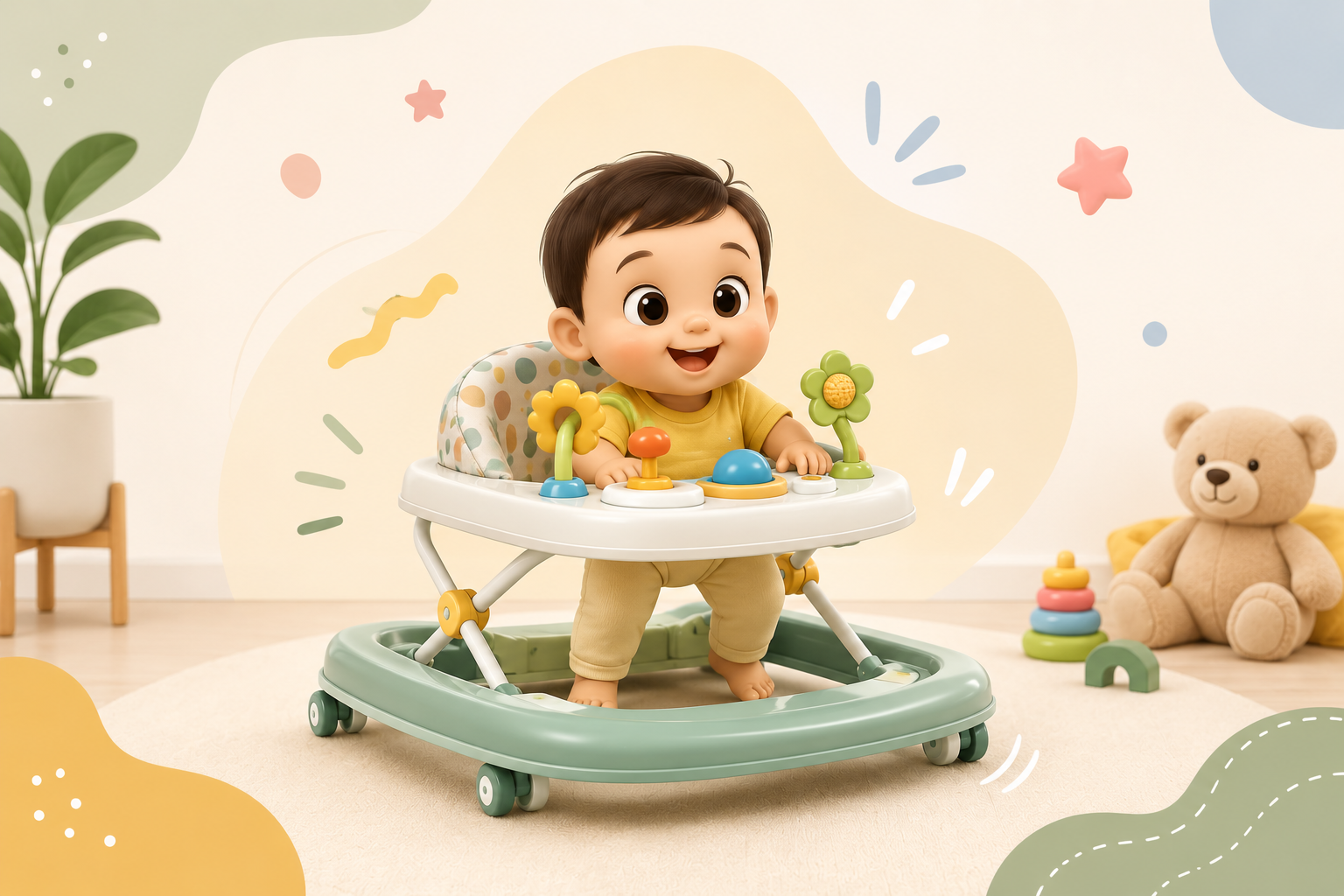
If you’ve just had a baby, chances are someone in the family has already suggested a walker — “it helped my son walk so early!” It’s one of the most gifted, most bought, and most quickly abandoned pieces of baby gear in Indian households. So let’s settle the big question first.
Short answer: No. Baby walkers do not help babies walk faster — and pediatric associations have actually flagged them as a safety concern rather than a developmental aid.
Here’s everything to know before you add one to your cart.
Quick Answer
| Question | Answer |
|---|---|
| Do walkers speed up walking? | No — research shows they can actually delay independent walking |
| How long do most babies actually use one? | 1–2 months on average, before parents stop using it |
| Are they safe? | No — leading pediatric bodies recommend against them due to fall and injury risk |
| Is there a better alternative? | Yes — furniture cruising and push toys (even a repurposed stool or chair) |
| Worth buying new? | Rarely — most parents say it wasn’t worth the money |
Why Walkers Don’t Actually Teach Babies to Walk
Walkers seem logical on paper — baby is upright, legs are moving, surely that’s practice? But real walking is a full-body skill: babies need to learn to balance on their own two feet, engage their core, and coordinate their weight shift without support.
A walker does the opposite. The seat holds the baby’s weight, so their leg muscles and core barely have to work. Many babies in walkers end up moving by pushing off with their toes while leaning back into the seat — a movement pattern that doesn’t resemble actual walking at all. Some studies have found walker use is linked to a delay in reaching independent walking milestones, not an advantage.
The 1–2 Month Reality Check
Seated walkers shouldn’t be introduced at all in the early months — most pediatric guidance points to 9+ months as the earliest reasonable age, once a baby already has some sitting and standing control. Push walkers (the no-seat kind babies stand behind and push) are even later, generally recommended from 11+ months, once a baby can already stand and take some steps with support.
Ask around any parenting group and you’ll hear a familiar pattern: the walker gets bought (or gifted) with excitement, used enthusiastically for a few weeks once the baby crosses that age, and then quietly retired within 1-2 months — either because the baby has outgrown the seat height, started pulling up on furniture instead, or a fall/near-miss scared the parents off it entirely.
That’s a lot of shelf space (and money) for something with such a short shelf life — which is exactly why the resale and preloved market for walkers is so active. If you do want to try one, buying preloved and reselling it quickly after makes far more financial sense than buying new.
The Real Dangers of Baby Walkers
This is the part that doesn’t get talked about enough:
- Falls down stairs are the single most common walker-related injury — babies in walkers move fast (up to 1 metre per second) and can reach a staircase before an adult can react.
- Increased mobility, decreased supervision margin — walkers let babies reach hot stovetops, cords, cleaning supplies, and sharp table edges they couldn’t otherwise get to.
- Tipping over on uneven flooring, thresholds, or rugs is common, especially in Indian homes with mixed flooring levels between rooms.
- False sense of security — because the baby looks “contained,” caregivers often step away, which is when most accidents happen.
- Delayed motor development in some studies, as discussed above.
- Seated walkers carry a much higher fall risk than push walkers — because the baby’s weight sits inside the frame at speed, a tip-over or a stair fall happens with far less warning and far more force than with a standing push walker, where the baby is already bearing their own weight and moving slower.
The one rule that matters more than any other: never leave a baby alone in or near a walker, even for a few seconds. Always use it only when an adult is right there, actively watching — not just “in the room.” Most serious walker injuries happen in the brief window when a caregiver steps away to answer the door, check the stove, or grab something from another room.
Pediatric bodies including the American Academy of Pediatrics have called for a ban on the sale and manufacture of mobile baby walkers altogether, given how consistently they show up in emergency room visits for infants.
What Parents Are Actually Doing Instead
Talking to parents on IPF, the alternatives are refreshingly simple — and free or nearly free:
1. Furniture cruising Babies who are supported by holding onto a sofa, coffee table, or bed frame and cruising along it tend to build genuine standing balance and leg strength. This is the natural pre-walking stage pediatricians actually recommend supporting.
2. A repurposed push chair or stool This is the one parents love to share — an ordinary sturdy chair or a low stool, pushed in front of the baby, gives them something to hold and walk behind. It’s stable, weighted, low to the ground, and costs nothing extra if you already have one at home. Unlike a walker, the baby is doing the actual work of balancing and stepping.
3. Dedicated push walkers (non-seated) If you want something purpose-built, the wheeled, no-seat “push walker” toys (baby stands and pushes it forward) are a genuinely safer category than the seated walker — because the baby bears their own weight the whole time.
4. Supervised floor time and bare feet Simple, but pediatricians consistently point back to this: unrestricted floor time, with bare feet for better grip and sensory feedback, does more for walking readiness than any gadget.
So — Should You Buy One?
If a walker is already at home or handed down, the honest answer is: it’s not going to help your baby walk earlier, and it comes with real safety trade-offs — so if you use it at all, keep sessions short, always supervised, on flat ground, and nowhere near stairs.
If you’re deciding whether to buy one new, most parents who’ve been through it will tell you: save the money. A stool to push around achieves the same (safer) result for free.
FAQs
Do walkers help babies walk faster? No. Research suggests walkers can delay independent walking rather than speed it up, since they reduce the need for babies to balance and use their leg muscles.
How long do babies typically use a walker before parents stop? Most parents report using a walker for only about 1-2 months before switching away from it — either the baby outgrows it or safety concerns take over.
At what age can a baby use a walker? Seated walkers are best avoided before 9+ months, once a baby has some sitting and standing control. No-seat push walkers are generally recommended even later, from 11+ months, once the baby can already stand and step with support. Seated walkers should never be used at 5-6 months, despite being commonly marketed for that age.
What is a safer alternative to a baby walker? Furniture cruising, supervised floor time, and pushing a sturdy stool or chair are all considered safer and equally (or more) effective for building walking skills.
Are baby walkers banned anywhere? Canada has banned the sale of baby walkers outright. Pediatric associations in the US and elsewhere have recommended against their use, though they remain legally available in many countries including India.
Is it safe to buy a preloved walker? If you choose to use one at all, buying preloved makes more financial sense given the very short actual usage window — just check the harness, wheels, and locking mechanism are all intact before use.
Not sure if it’s worth buying new? Browse preloved baby walkers, push toys, and other gently-used baby gear on IPF — with doorstep pickup, drop, and escrow-protected payments, you can try before you fully commit, and resell easily if it’s not a fit for your little one.