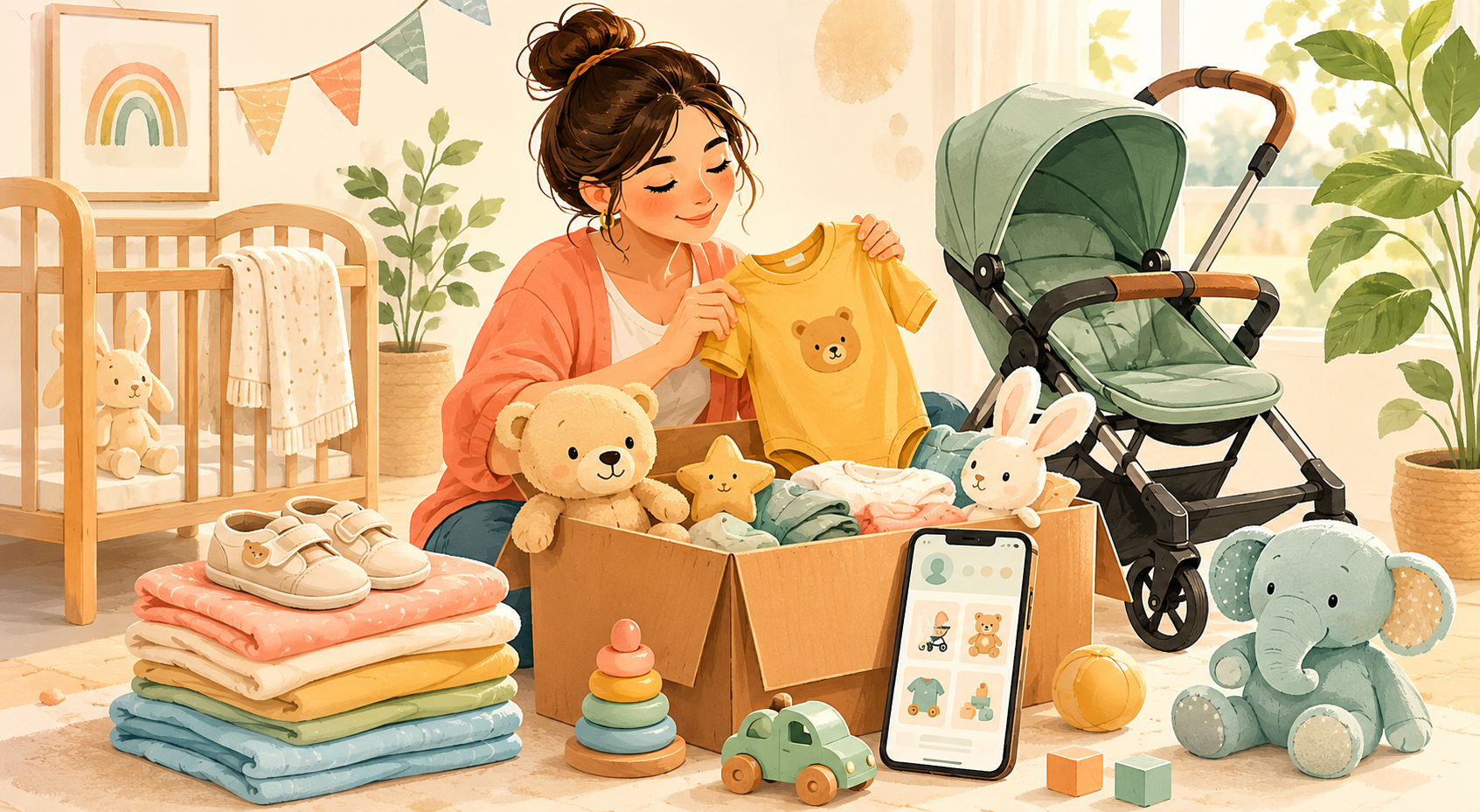
You bought the best stroller money could buy. The fancy high chair with five reclining positions. The musical activity gym that kept your baby entertained for exactly three months. And now? All of it is stacked in a corner of your bedroom, collecting dust and quietly judging you every morning.
Here’s the truth most parenting advice skips: baby gear has one of the shortest use windows of anything you’ll ever buy. A newborn becomes a rolling, crawling, toddling force of chaos faster than you can say “what happened to my easy baby?” And with every developmental leap comes a corner of your home that looks like a baby gear graveyard.
But those items aren’t dead weight. They’re value waiting to be unlocked — and another parent somewhere in India is right now searching for exactly what’s sitting unused in your house.
This guide walks you through everything you need to know to sell your baby’s outgrown items confidently: what to sell, how to price it, how to photograph it, and how to make the whole process feel easy rather than overwhelming.
Why Reselling Baby Items Makes Complete Sense
In many Indian households, the idea of buying or selling used baby products comes with a lot of side-eye. “Log kya kahenge?” is real. There’s an unspoken assumption that buying second-hand means you can’t afford new, or that selling your child’s things is somehow inauspicious.
But that narrative is changing — fast.
Urban Indian parents, particularly millennials, are leading a quiet shift in how they think about baby gear. They’ve done the math. A good-quality stroller costs ₹8,000–₹25,000. Your child uses it actively for 12–18 months. Why wouldn’t you recover 50–60% of that cost once it’s outgrown?
Reselling baby items isn’t a compromise. It’s smart parenting. It’s the same logic that drives parents in Japan, Germany, and the UK to build entire economies around preloved children’s goods — and Indian parents are absolutely catching up.
What Baby Items Are Worth Reselling?
Not everything needs to go. But you’d be surprised how much demand exists for the following categories:
Big-ticket gear (highest resale value):
- Strollers and prams
- Baby cots, cribs, and bassinets
- High chairs and booster seats
- Baby carriers and slings
- Baby swings and bouncers
- Nursing chairs
Activity and play items:
- Activity mats and gyms
- Walkers and ride-on toys
- Baby rockers
- Musical and sensory toys
Feeding and care accessories:
- Breast pumps
- Sterilisers
- Bottle warmers
- Feeding sets
Clothing and textiles:
- Baby clothing bundles (grouped by size)
- Swaddle sets
- Sleep sacks
Learning and books:
- Board books
- Flashcards
- Early learning toys
A useful rule of thumb: If it’s clean, structurally sound, and free of safety recalls, another parent wants it.
Step 1: Decide What to Let Go
Go room by room and ask yourself honestly: Has my child used this in the last month? Will they use it in the next three months? If the answer is no to both, it’s ready for a new home.
Create three piles: Sell, Keep, and Discard. The discard pile is for anything genuinely worn out, broken, or past its safe use date — items with cracked plastic, missing safety components, or significant structural damage shouldn’t be resold.
For everything else, the sell pile is your starting point.
Step 2: Clean and Prepare Like You Mean It
This is the step most sellers skip, and it’s the reason their listings sit unsold for weeks.
First impressions in a preloved marketplace work exactly like first impressions everywhere else: you get one shot, and appearance matters enormously. A well-presented item signals that it was loved and cared for — which is exactly what every buying parent wants to hear.
Your pre-listing checklist:
- Wash all fabric items — pram liners, high chair covers, carrier inserts, clothing
- Wipe down plastic and metal surfaces with a mild disinfectant
- Check for and note any missing parts, loose screws, or cosmetic damage
- Remove personal stickers, name labels, or customised markings
- For electrical items, confirm they power on and function correctly
- Set the item up as it would be used — this makes photography easier and helps you catch anything you missed
A clean, fully functional item with honest disclosures will always outperform a dirty item listed “gently used”
Step 3: Take Photos That Actually Sell the Item
Photography is where most preloved listings succeed or fail. You do not need a professional camera. You need good light and a few minutes of effort.
What makes a listing photo work:
- Natural light is your best friend. Photograph near a window or outdoors in shade. Avoid harsh midday sun and flash photography, which flatten texture and wash out colour.
- Show multiple angles. Front, back, side, top, and bottom where relevant. Buyers cannot touch the item — your photos are their hands.
- Capture close-ups of wear. Any scratches, scuffs, fading, or marks should be clearly visible in at least one photo. This isn’t a disadvantage — it’s trust-building. Buyers who see honest wear photos are far less likely to raise disputes later.
- Include scale context. For items like cots or strollers, include something that indicates size — a toy, a hand, a common object.
- Show it assembled and functioning. A folded stroller tells buyers nothing. A video of the stroller standing open, wheels on the floor, shows them what they’re actually getting.
For most items, 5–8 photos is ideal. A high chair listing with eight clear photos will always outperform one with a single blurry shot. Adding a video of the product increases the chance of sale by 30%
Step 4: Write a Description That Answers Every Question Before It’s Asked
Buyers have a mental checklist before they’ll commit to an inquiry. Your listing description should clear that checklist before they even have to ask.
What to include:
- Brand and model name — “Chicco Polly High Chair” not just “high chair”
- Age suitability of the product (not your child’s current age)
- Purchase year — a 2023 stroller is meaningfully different from a 2019 one
- How long it was used — “used for 8 months” tells buyers about wear level
- Condition — be specific. “Good condition with minor scratches on the footrest” is far more trustworthy than “excellent condition”
- What’s included — list accessories, manuals, original packaging if available
- Reason for selling — “my child has outgrown it” is reassuring; it tells buyers the item wasn’t sold due to a problem
Step 5: Price It to Move
Pricing is where emotions and logic often collide. You remember what you paid. You remember how excited you were to buy it. Neither of those things is relevant to a buyer.
A practical pricing framework for Indian parents:
- Items in excellent condition (minimal use, like new): 50–60% of original retail price
- Items in good condition (normal wear, fully functional): 30–45% of original retail price
- Items in fair condition (visible wear but functional): 15–25% of original retail price
Factors that increase resale value:
- Original packaging and accessories included
- Premium or trusted brands (Chicco, Graco, Fisher-Price, Babyhug, Mee Mee)
- Low usage period (under 6 months)
- Recent purchase year
Factors that reduce resale value:
- Missing parts or accessories
- Significant visible wear or staining
- Budget or less-recognised brands
- Older purchase year
One practical tip: Browse similar listings on the IPF app before you price. See what comparable items are listed at and what seems to be getting inquiries. Price competitively — the goal is a sale, not maximum recovery.
Step 6: List Your Item on IPF
The IPF app is built specifically for buying and selling preloved baby products within a community of Indian parents — which means your buyers aren’t random strangers; they’re other parents who understand exactly what they’re looking for.
To list an item:
- Open the IPF app
- Tap “Sell”
- Upload your photos (add the clearest, most appealing image first)
- Fill in item details — category, brand, condition, age suitability
- Write your description
- Set your price
- Publish your listing
Your listing is now visible to thousands of parents across India who are actively searching for preloved baby products.
Why sell on IPF rather than a general marketplace?
IPF is a Parenting based peer-to-peer marketplace. IPF’s platform includes in-app secure chat and escrow-based payments — meaning both buyers and sellers are protected throughout the transaction. The small commission and shipping fees aren’t a tax on your sale; they’re the infrastructure that makes every transaction safe and trustworthy for both sides.
Additionally, we provide a Buyer Protection Program, through which you get a 100% refund, if you raise the issue within 48 hours of delivery.
Step 7: Respond Promptly and Communicate Clearly
Once your listing goes live, treat every inquiry as a live sale in progress.
A buyer who messages you about a stroller at 9pm is comparing your listing to two others. If you respond within 30 minutes, you’ve already separated yourself from most sellers. If you respond the next afternoon, they’ve likely moved on.
Communication best practices:
- Answer every question fully, even if it’s already in your description — some buyers skim
- Offer to share additional photos and videos for specific areas of concern
- Be honest if you’ve received multiple inquiries — it creates gentle urgency
- Keep all communication within the IPF platform, which protects both parties
Trust is the currency of preloved transactions. Clear, prompt, honest communication is how you earn it.
Step 8: Complete the Transaction Safely
IPF’s platform is designed to make transactions smooth and secure for both sides.
A few principles to follow:
- Never share your bank account details or UPI ID outside the platform’s secure payment flow
- Create an unboxing video and inspect the product carefully upon delivery.
- Avoid sharing personal information and make use of the in app chat for your safety.
Honest sellers who describe their items accurately almost never face disputes. Your listing description and photos are your protection.
The Bigger Picture: Why This Matters Beyond the Money
Every baby item you resell instead of discarding does something more than recover cash.
Reselling extends the useful life of a product that took resources to manufacture. It means one less item in a landfill. And it means a parent in a smaller city or with a tighter budget gets access to quality gear they might not otherwise afford. And it means you — the seller — are actively participating in a shift that’s making Indian parenting culture more practical, more honest, and less driven by the pressure to always buy new.
“Preloved” isn’t a compromise word. It’s a values word. And Indian parents are increasingly owning it.
Frequently Asked Questions
Is it safe to sell baby items online in India? Yes — particularly on platforms like IPF that are designed specifically for parent-to-parent transactions, with built-in secure chat, escrow payments, and community trust features.
What baby items cannot be resold? Not all baby products are suitable for resale. Consumable items, such as opened feeding products, personal care items, or partially used supplies, are generally discouraged because their safety and quality cannot be reliably verified. Items with recalled components, broken structural parts, or missing safety mechanisms should not be listed.
How do I price my old baby clothes? Bundle by size and condition. A clean bundle of 8–10 items in the same size typically sells better than individual pieces. Price the bundle at 20–35% of what the items would cost new at Indian retail.
Will buyers in India buy preloved baby items? Yes — and this segment is growing rapidly. Urban Indian parents, particularly in metros and Tier 1 cities, are increasingly comfortable with preloved purchases for non-consumable baby gear. Platforms like IPF are specifically built around this growing demand.
How long does it take to sell baby items? Well-priced, well-photographed listings on IPF typically receive inquiries within a few days. Big-ticket items like strollers and high chairs in good condition tend to move faster than smaller accessories.
Ready to Turn Your Baby’s Outgrown Gear Into Cash?
Your child’s first year left behind a collection of gear that served its purpose beautifully. Now it’s time to let it serve another family just as well.
The IPF app makes listing simple, the audience is ready, and the process is designed to keep you protected from listing to delivery.
Download the IPF app today. List your first item in under ten minutes. Another parent is already looking for exactly what you have.