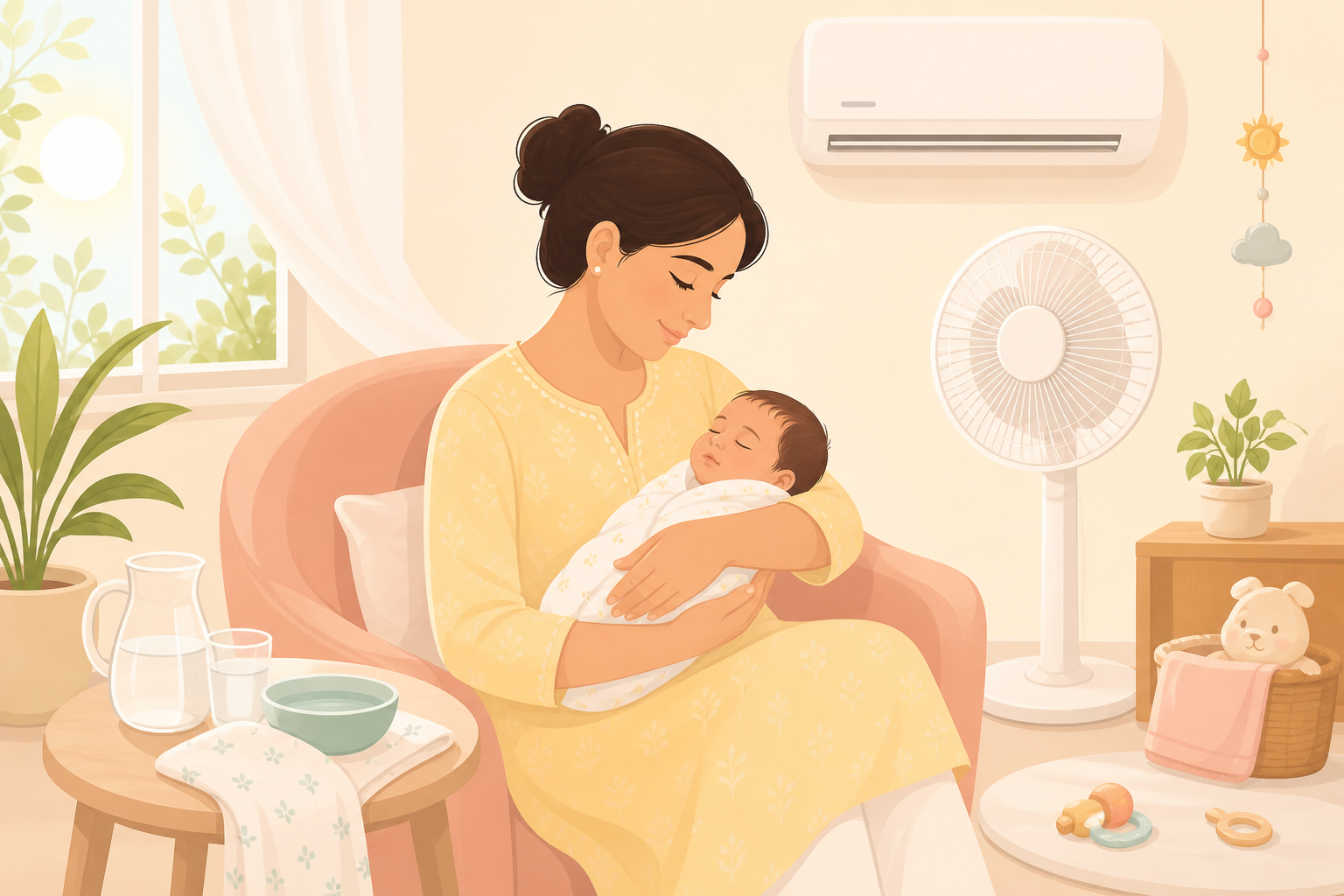
There’s a particular kind of anxiety that comes with being a new parent in May. The temperature outside is already touching 40°C, your newborn has no way to tell you if they’re uncomfortable, and the advice is pouring in from every direction – Your family, friends and even the internet.
Should you use the AC? Is the fan too direct? Do you add water to feeds? Is that rash serious?
Take a breath. This guide has you covered.
We’ve put together everything you need to know about keeping your newborn safe, comfortable, and happy through an Indian summer — combining current paediatric guidance with the kind of real-world context that actually makes sense in an Indian home.
Why Indian Summers Are Especially Challenging for Newborns
Indian summers can get rather intense between March to June with temperatures hitting 40–45°C in cities like Delhi, Nagpur, and Ahmedabad, and relentless humidity in coastal cities like Mumbai, Chennai, and Kolkata.
Here’s what makes it particularly tough for newborns:
- Newborns cannot regulate their body temperature. Unlike adults, they can’t sweat efficiently or shiver. Their bodies depend almost entirely on their environment — and on you.
- Their skin is 30% thinner than adult skin, making them far more prone to sunburn, rashes, and dehydration through the skin.
- They cannot communicate discomfort. A baby crying could mean overheated, thirsty, or just gassy. Knowing the difference is crucial.
The good news: once you know what to look for and what to do, Indian summers are very manageable — even for a first-time parent.
Keep the temperatures Cool
- Set the AC temperature between 24-26°C, this is the medical recommendation.
- Make sure the AC vent is not directly pointed at the baby
- Fan should be kept at a moderate speed and make sure baby is positioned slightly away from direct airflow.
- For humid cities like Mumbai and Chennai, using both a fan and AC together improves comfort.
- In air conditioned rooms, the air can become quite dry. While placing a bowl of water helps add some moisture, parents also consider using a humidifier to maintain comfortable humidity levels, especially if the baby shows signs of dry skin or nasal dryness.
Should You Give Water to a Newborn in Summer?
Dehydration is the biggest summer risk for newborns, and the terrifying part is that babies can become dehydrated before you notice anything is wrong.
For babies under 6 months (exclusively breastfed): Breast milk is actually mostly water – around 88%. Contrary to what many families are advised, you do not need to give water separately if you are exclusively breastfeeding. What you do need to do is feed more frequently. Offer the breast every 1.5–2 hours in the heat rather than waiting for the baby to cry.
For formula-fed babies: Talk to your paediatrician about whether to offer small amounts of cooled boiled water between feeds during peak heat. Do not dilute formula — this can dangerously lower the nutrient content.
For babies 6 months and above: You can offer small sips of cooled boiled water, fresh coconut water, and high water-content fruits and vegetables like cucumber and watermelon.
What to Dress Your Newborn in During Summer
Dressing babies in summer is crucial for summer comfort. Babies generally require just one extra layer than adults in the same environment.
Simple Summer Outfit Idea: A lightweight Onesie and Breathable sleepsack.
Best fabrics:
- Muslin cotton — the gold standard. Lightweight, breathable, gets softer with every wash.
- 100% cotton knitwear — stretchy, gentle on skin, good air circulation.
- Malmal — traditional Indian cotton, perfect for summers.
Avoid:
- Synthetic fabrics (polyester, nylon) — they trap heat and sweat.
- Tight elastic waistbands and cuffs — restrict circulation and trap sweat.
- Thick nappies or plastic-backed diapers for long periods — change frequently to allow skin to breathe.
Colour matters too: Dress your baby in light colours when outdoors. White and pastels reflect heat; dark colours absorb it.
How to Protect Babies from Heat Rashes?
Babies under 6 months should be kept out of direct sunlight. Even older babies should be kept out of the sun as much as possible, particularly avoid going out between 11 AM- 4 PM, when the sun is at its strongest.
Do Babies need Sunscreen?
- Under 6 months: Sunscreen is not recommended. Keep babies entirely in shade. Dress in full-coverage, lightweight cotton with a soft hat.
- 6 months and above: Use a mineral sunscreen (zinc oxide or titanium dioxide based) with at least SPF 30–50, designed for babies. Apply 15 minutes before going out.
- For Parent recommended Sunscreens check here.
- Avoid peak sun hours: 10 AM to 4 PM is when UV intensity is highest.
Going Outdoors: When, How, and What to Carry
Some outdoor time is still healthy and necessary — early morning sun exposure (before 9 AM) actually helps newborns synthesise Vitamin D and reset their body clock.
The golden rule: Step out before 10 AM or after 5 PM.
What to carry every time:
- A wide-brimmed baby hat
- Muslin swaddle or light wrap (useful as a sun shield in the pram)
- Extra set of light clothes
- For breastfeeding moms: a cool pack or insulated bag for expressed milk
Stroller tips:
- Use the Stroller’s built-in canopy — never drape a blanket or muslin over it.
- Some parents use a clip-on parasol for extra shade; this is safe and effective.
- In the car: window sun shades are essential, and never leave a baby in a parked car even for two minutes.
Signs of Overheating — When to Act Fast
Overheating in a newborn can escalate quickly. Know these warning signs:
Mild overheating:
- Skin feels warm and damp to touch
- Flushed face
- More irritable than usual
- Feeding less
What to do: Move to a cooler room, remove a layer of clothing, offer a feed, and apply a cool (not cold) damp cloth to the forehead, nape, and wrists.
Serious overheating (heat exhaustion / heat stroke):
- Rapid breathing
- High fever (above 99°F in a newborn is always an emergency)
- Limp or unresponsive
- Vomiting
This is a medical emergency. Call your doctor or go to a hospital immediately.
Your Summer Newborn Checklist
Before you feel overwhelmed, remember: you don’t need to get everything perfect every day. Here’s a simple daily checklist to anchor you:
- Offer feeds every 1.5–2 hours (or more if baby seems hot)
- Check for wet diapers — at least 6 per day
- Change diapers every 2–3 hours
- Allow 10–15 minutes diaper-free time
- Keep room ventilated and reasonably cool
- Check the back of baby’s neck — warm and sweaty = too hot, remove a layer
- Step outdoors only before 10 AM or after 5 PM
- Inspect skin folds (neck, underarms, groin) for rashes daily
Looking for the right summer wardrobe for your newborn without breaking the bank? Babies outgrow summer clothes in weeks — browse preloved, verified baby essentials on IPF and give quality items a second life.