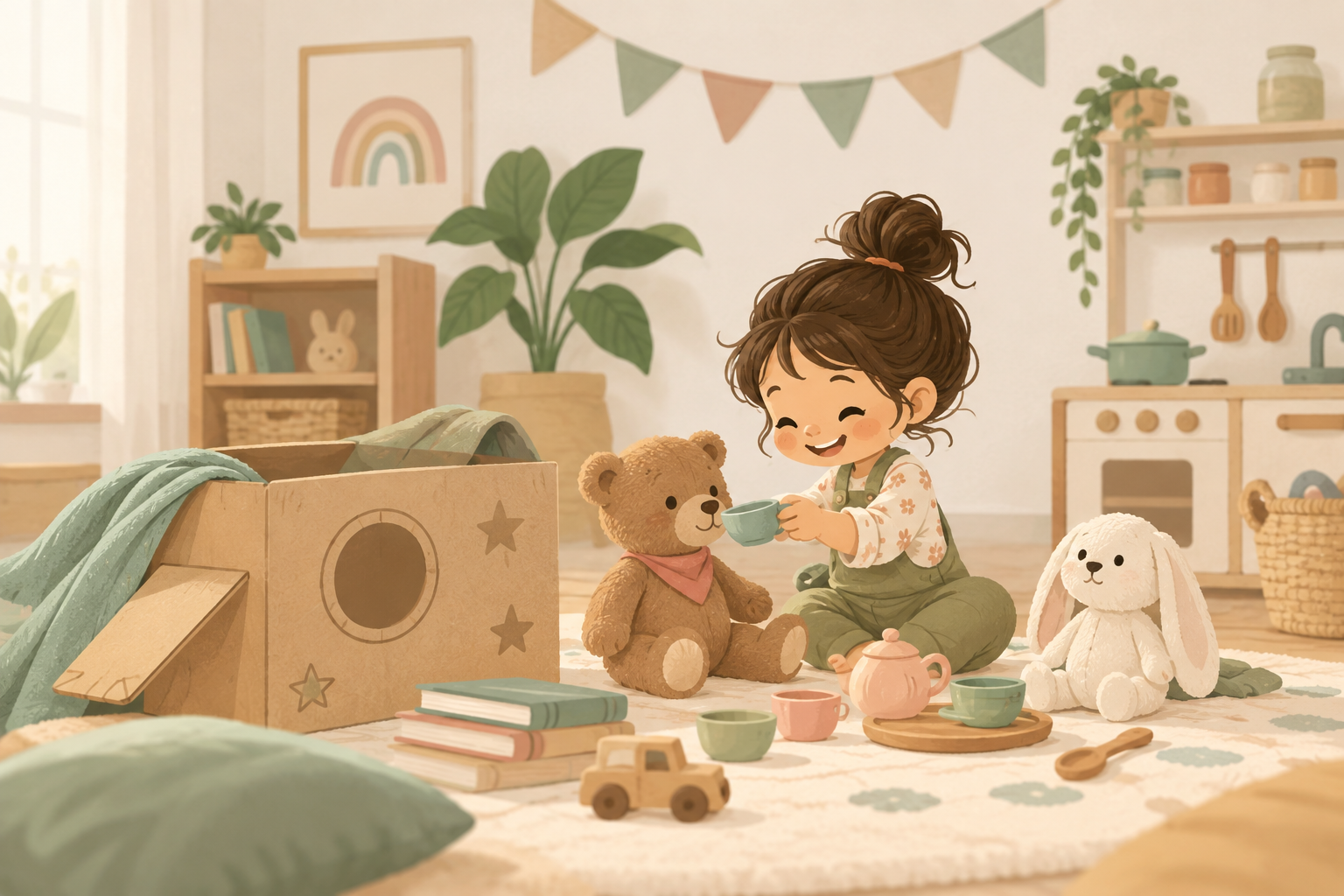
If your toddler has ever fed a “hungry” teddy bear, talked into a TV remote like it’s a phone, or insisted that a cardboard box is actually a rocket ship — congratulations, you’re watching one of the most important things a young brain can do.
It’s called pretend play (also known as imaginative or make-believe play), and it looks a lot like fun because it is fun. But underneath the giggles, your toddler is quietly building language, emotional regulation, problem-solving, and social skills — all at once.
Here’s what pretend play actually does for your child, when it usually starts, and 10 simple ways to encourage more of it at home.
What Is Pretend Play, and When Does It Start?
Pretend play is when a child uses an object, action, or role to represent something else — feeding a doll, “talking” on a toy phone, or turning a block into a car. It doesn’t need a script, a costume, or expensive props. It just needs a little imagination and, ideally, a grown-up who’s willing to play along.
Most children move through pretend play in fairly predictable stages:
| Age | What it typically looks like |
|---|---|
| ~12–18 months | Simple, realistic pretending — “feeding” a stuffed animal, holding a toy to their ear like a phone |
| ~2 years | Symbolic play begins — a box becomes a crib, a block “meows” like a cat, an empty bowl is imagined as full |
| 3–5 years | The “high season” of imaginative play — detailed stories, fantasy worlds, and dramatic role-play with other children |
Every child moves through these stages at their own pace, so there’s no need to rush it. Pretend play is a skill that grows over time rather than a milestone your toddler either hits or misses.
Why Pretend Play Matters So Much
It’s tempting to file pretend play under “cute toddler behaviour,” but research points to some real, lasting benefits:
- Creativity and problem-solving — because pretend play has no rules, kids practice thinking flexibly and finding new uses for ordinary objects.
- Emotional skills — soothing a “crying” doll or acting out an angry monster gives toddlers a safe way to explore and regulate big feelings.
- Social skills — playing pretend with siblings or friends means negotiating roles, sharing a storyline, and understanding that other people have their own thoughts and feelings.
- Executive functioning — holding the line between “pretend” and “real” strengthens memory, attention, and flexible thinking.
- Language development — kids who build elaborate make-believe stories tend to have stronger vocabularies and storytelling skills later on.
In short: the pretend tea party on your living room floor is doing more heavy lifting than it looks like.
How to Encourage Pretend Play in Toddlers
1. Start with what they already love
Toddlers usually gravitate toward pretending with things they see every day — feeding a doll, talking on a toy phone, cooking in a play kitchen, or “driving.” Follow their interests instead of deciding what they should play.
2. Let everyday objects become toys
You don’t need a house full of pretend-play toys. An empty cardboard box can become a car, a spoon can become a microphone, and a blanket can become a superhero cape. Open-ended objects give toddlers more room to use their imagination than toys with only one “correct” use.
3. Join their play without taking over
Get down to their level and play alongside them. If they’re feeding a teddy, try “Oh, Teddy is hungry!” instead of directing what should happen next. Let them stay the leader — your job is to follow, not steer.
4. Give them a few simple props
A handful of basic props can spark hours of imaginative play:
- Toy kitchen and pretend food
- Dolls or stuffed animals
- A doctor kit
- Toy vehicles
- Pots, pans, and utensils
- Old bags, scarves, or hats
- Cardboard boxes
5. Turn everyday routines into pretend play
Toddlers love copying adults. Pretend to cook dinner, go grocery shopping, wash the baby’s clothes, run a little café, or pack a bag for a “trip.” Familiar experiences make pretend play easier for toddlers to understand and recreate.
6. Use stories as inspiration
After reading a favourite book, let your toddler recreate parts of it. Read about animals? Pretend to run a little animal clinic or set up a zoo with their toys.
7. Don’t worry if it looks repetitive
Toddlers may make the same cup of “tea” ten times or put the same doll to sleep over and over. Repetition is part of how they explore an idea and make sense of it — not a sign that they’re bored or stuck.
8. Encourage pretend play without correcting it
Their version of reality doesn’t have to make sense to you. If a block is a “phone” today, play along. Imaginative play is about creativity, not getting the details right.
9. Give them uninterrupted time to play
Pretend play often needs time to unfold. Instead of filling every free moment with activities, leave some unstructured time where your toddler gets to decide what happens next.
10. Follow their imagination
Sometimes the best thing you can do is simply ask, “What are we pretending today?” Their answer might go somewhere completely unexpected — and that’s the fun of it.
Pretend Play Ideas Using Things You Already Have at Home
You genuinely don’t need a shelf of new toys to get started. Most Indian homes already have everything needed for a good pretend-play session:
- Steel dabbas and a ladle → instant “kitchen” for cooking pretend food
- An old dupatta or scarf → cape, veil, picnic blanket, or baby’s “blanket”
- A shoebox or courier box → car, doli, treasure chest, or “shop counter”
- Empty spice tins and a thali → a whole restaurant, ready to serve
- Old handbags, wallets, or a expired debit card → “office” or “shopping” play
- A torch → doctor’s checkup light or a “campfire”
- Leftover bubble wrap or newspaper → wrapping presents for a pretend birthday
- A phone-shaped remote or calculator → the classic first pretend-play prop
If your toddler has outgrown a play kitchen, doctor kit, or dollhouse that’s been sitting in a corner, it doesn’t need to go to waste — it could become someone else’s toddler’s favourite prop. If you’re clearing out toys your child has moved on from, our guide on how to sell your baby and kids’ toys on IPF walks you through listing them safely, with escrow protection and doorstep pickup, so they find a new home instead of a landfill. And if you’re the one looking to add a few pretend-play props without spending full price, browsing preloved toy listings on IPF is often the easiest way to pick up a play kitchen, doctor kit, or dollhouse that another IPF family has already loved and outgrown.
A Quick Word on “Is My Toddler Pretending Enough?”
Most toddlers develop pretend play at their own pace, and there’s a wide range of what’s typical. Simple pretending (like “talking” on a toy phone) often starts around 12–18 months, and richer, story-based pretend play usually builds up by age 2–3. If by around age 2 your toddler shows very little interest in pretend or imitative play, or their play stays repetitive without any growth into little stories or roles, it’s worth mentioning at your next paediatrician visit — just as one more data point, not a cause for alarm on its own.
FAQs on Pretend Play in Toddlers
At what age does pretend play start? Simple pretending, like holding a toy phone to the ear or “feeding” a stuffed animal, often starts around 12–18 months. Symbolic play — where one object stands in for another, like a block becoming a “cat” — usually emerges around age 2, and ages 3–5 are considered the peak years for imaginative play.
Do I need special toys for pretend play? No. Open-ended items — cardboard boxes, kitchen utensils, old scarves — often spark more imagination than single-purpose toys because they can become anything. A few basics (dolls, a play kitchen, a doctor kit) help, but they’re not essential.
Is it okay if my toddler plays the same pretend game over and over? Yes — repetition is a normal and healthy part of how toddlers process and explore an idea. It’s not a sign that they’re bored or that something is wrong.
How much time should toddlers spend on pretend play? There’s no fixed number, but toddlers benefit from having some unstructured, unscheduled time every day where they can choose what to play, rather than every slot being filled with a structured activity.
Should I correct my toddler if their pretend play “doesn’t make sense”? No. Pretend play is about creativity, not accuracy. If a spoon is a microphone or a blanket is a spaceship, go with it.
When should I be a little concerned about pretend play? Occasional disinterest is normal, but very limited pretend or imitative play by around age 2, combined with limited interest in playing alongside others, is worth raising with your paediatrician as one part of the bigger picture — not something to self-diagnose.
Pretend play doesn’t need to be complicated, expensive, or Pinterest-perfect. Your toddler mostly needs time, a few simple props, and permission to lead — and their imagination will do the rest. If you’re building out (or clearing out) a pretend-play corner at home, IPF’s preloved marketplace is a good place to start, with free listings for sellers, a small buyer commission, and doorstep pickup so you don’t have to leave the house.