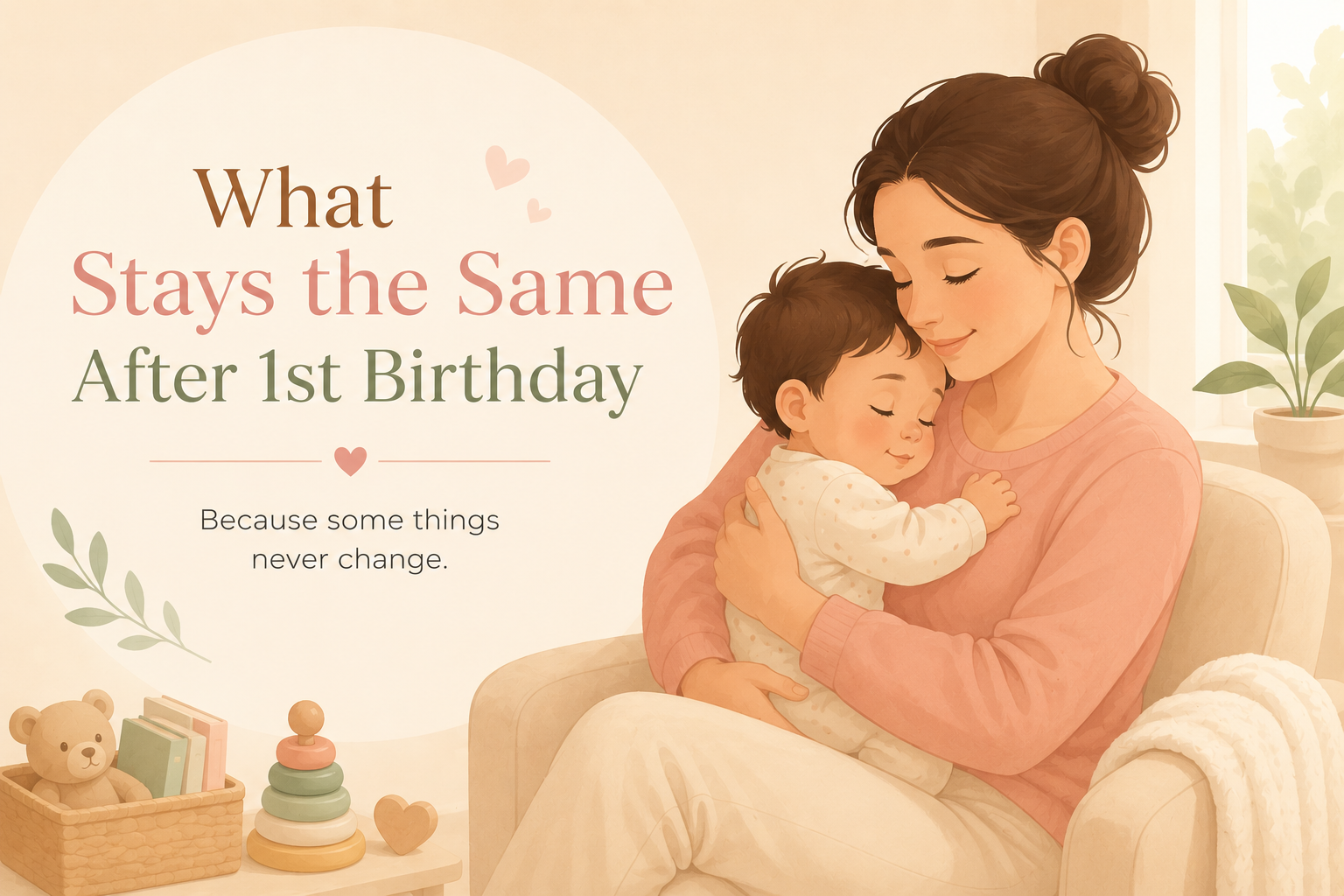
After the first birthday, parents often notice huge changes — stronger opinions, messy mealtimes, sleep disruptions, endless movement. But underneath all of that growth, your toddler is still deeply attached to you in many of the same ways
In Part 1, we explored the external changes after turning one. This guide focuses on the emotional side of toddlerhood — what stays the same.
What Stays the Same
This is the part nobody writes enough about. And it’s often the part Indian parents find most reassuring — and most surprising.
Why Toddlers Still Need Comfort After 1 Year
One of the biggest myths around toddlerhood is that independence means needing less comfort. In reality, toddlers seek just as much, if not more — physical reassurance as babies. Being carried, snuggled, held, patted to sleep: these needs don’t disappear at 12 months. They evolve slowly, on their own timeline.
In many Indian families, extended contact parenting – co-sleeping, carrying, constant access — is the norm, not the exception. That instinct is supported by developmental research. Closeness doesn’t create dependence. It creates a secure base from which children eventually venture out.
Separation Anxiety After 1 Year Is Normal
Here’s something that surprises many parents: separation anxiety often peaks around 12-18 months, not before. This is because babies now understand object permanence fully — they know you exist when you’re gone, and they’d like you to come back immediately.
Crying at daycare drop-offs, clinging when one parent leaves for work, wanting only one caregiver during illness — all of this can intensify after one. It’s not regression. It’s a sign of healthy attachment.
How Toddlers Learn Through Play After 1 Year
There’s no need for flashcards or structured learning activities at this stage. Toddlers learn through repetition, exploration, and “purposeless” play that is anything but purposeless. Emptying the kitchen cabinet. Filling and dumping a container endlessly. Pulling everything off a low shelf and handing it back one item at a time.
These aren’t problems to manage — they’re experiments. Resist the urge to over-programme this stage. The best “activity” for a one-year-old in most cases is uninterrupted time to explore a safe space freely.
Toddler Milestones Develop at Different Speeds
Milestones exist as general guidance, not a race. At 12 months, some children are walking. Others won’t walk for another 4-5 months. Some have a handful of words. Others focus all their energy on mobility first and begin talking more clearly at 18 months. Both paths are normal.
In joint families, extended families, and WhatsApp groups, it’s easy to absorb comparative anxiety about what other children are doing. Try to resist it. The range of “normal” at this age is genuinely wide — and your child is on their own curve, not someone else’s.
Gear changes fast at this stage. Your wallet doesn’t have to suffer for it.
As your baby moves into toddlerhood, needs shift quickly — walkers, push toys, feeding essentials, bigger clothes. Find quality preloved baby and toddler products from verified Indian parents on the IPF app.
Final Thought
Your child is officially a toddler. They may have a cake-smeared birthday photo to prove it. But inside — in the part of them that still reaches for you when they’re tired, or gets scared by a ceiling fan at full speed, or collapses against your shoulder at the end of a long day — they are still the same small person who needed you completely on the first day.
What changes after one is mostly external: the mobility, the food, the gear, the schedule. What stays is the relationship. And that remains the most important thing — not just in the first year, but in every one that follows.
So celebrate the first birthday for what it is: not a graduation from babyhood, but a beginning of something new. A version of parenting that is louder, messier, and more surprising than before — but also richer in personality, in connection, and in moments you will remember for the rest of your life.