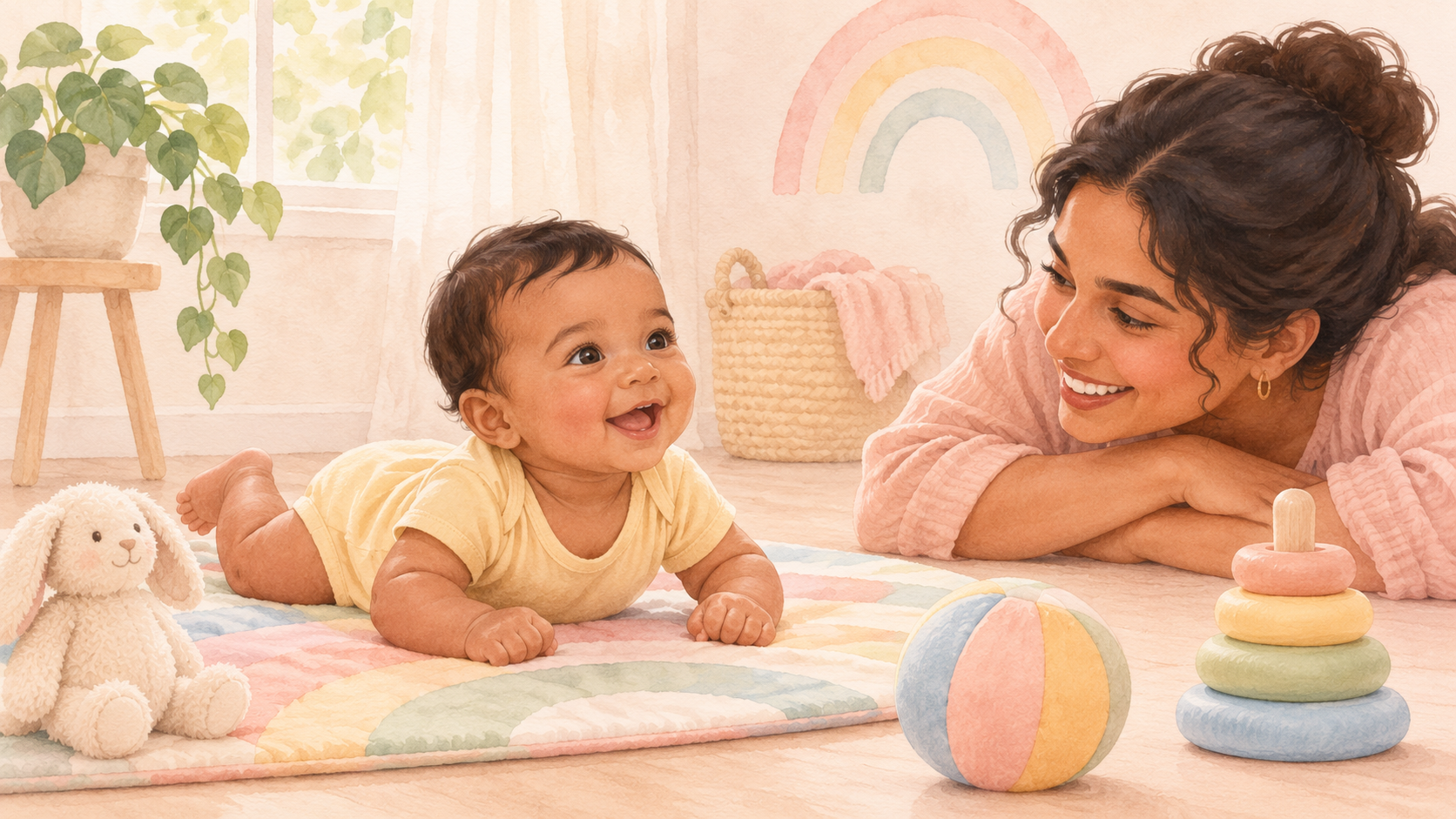
Quick answer: What is tummy time?
Tummy time means placing your baby on their tummy while they are awake and supervised. It is for play, never for sleep: babies should always be placed on their backs to sleep. For healthy newborns, the AAP suggests starting from the first day home with short sessions of 3–5 minutes, two or three times a day, and slowly building toward 15–30 minutes in total each day by about seven weeks. Small, regular moments matter more than one long session.
Quick-reference table
| Question | Short answer |
|---|---|
| What is it? | Awake, supervised time on the tummy |
| Sleep position? | Always on the back for sleep |
| When to start? | From the first day home (healthy newborns) |
| How long at first? | 3–5 minutes, 2–3 times a day |
| Goal by ~7 weeks? | About 15–30 minutes total per day, built up gradually |
| Best time? | After waking or a diaper change, not right after a feed |
| Who should supervise? | An awake, attentive adult, every time |
What is tummy time (and how is it different from sleep position)?
Tummy time is simply play on the tummy while your baby is awake and someone is watching. That is all it is.
The key distinction is this: tummy time is for play, back is for sleep. Every sleep, day or night, should be on a firm, flat surface with baby on their back. Tummy time never replaces that rule, and a baby should never be left to doze on their tummy. If your baby falls asleep during tummy time, gently move them onto their back in their sleep space.
Source: AAP, Back to Sleep, Tummy to Play
Why tummy time matters
Tummy time gives your baby a chance to work muscles they do not use much on their back. It helps in a few gentle ways:
- Strengthens the neck and shoulders as baby lifts and turns their head.
- Supports movement skills such as pushing up, and later rolling, reaching and crawling.
- Helps reduce flat spots on the back of the head, since baby spends time off the back of their head.
What it does not do: it does not guarantee faster development, and skipping a day does not put your baby behind. Think of it as one helpful part of everyday play, not a race.
Source: NICHD, Safe Sleep Messages
A realistic tummy time routine (gradual, not a test)
For healthy newborns, the AAP recommends starting from the first day home. Here is a gentle build-up:
| Stage | What it can look like |
|---|---|
| Week 1 | 3–5 minutes, two or three times a day |
| Following weeks | Add a minute or two as baby tolerates it |
| Around 7 weeks | Working toward 15–30 minutes total across the day |
A few reminders:
- These are totals across the day, not one long stretch. Five short sessions count just as much.
- Your baby is not a test you need to pass. If today was only one minute, that is fine. Try again later.
- Follow your baby’s cues. A calm, interested baby can go a little longer; a fussy baby needs a break.
Source: AAP
Tummy time safety: the simple version
- Direct supervision, always. An awake, attentive adult stays with baby the whole time.
- Keep baby’s face clear. Nothing soft, loose or bulky near their nose and mouth.
- Use a safe floor space. A firm, flat, clean surface such as a play mat on the floor. Avoid sofas, beds and other soft or raised surfaces.
- Stop when baby is upset or sleepy. Roll them onto their back and try later.
Not ready for the floor yet? Try chest-to-chest tummy time. Lie back or recline, place your baby tummy-down on your chest, and stay fully awake and attentive. Many newborns love hearing your heartbeat and voice, and it is a lovely introduction. If you feel yourself getting sleepy, move baby to a safe flat surface.
Source: HSE Ireland, Tummy time
“My baby hates tummy time!” What can help
This is one of the most common worries in parent groups, and you are not alone. Many babies protest at first. Try:
- Shorter attempts. Even 1–2 minutes is a good start.
- Get down face-to-face. Lie on the floor at baby’s eye level so your face is the best thing in the room.
- Sing, talk or make silly sounds. Your voice is the best toy.
- Place an age-appropriate toy nearby, within sight and reach.
- Take breaks the moment baby becomes upset. Pushing through tears is not the goal.
- Avoid sessions right after feeding, especially if baby has reflux or tends to spit up.
If your baby consistently seems very distressed, or you are unsure about their comfort, mention it to your pediatrician.
Source: HSE Ireland
Play ideas that grow with your baby
These are ideas by stage, not deadlines. Babies reach each stage at their own pace.
| Stage | Play ideas |
|---|---|
| Newborn to ~2 months | Faces, voices and gentle songs; a high-contrast card or toy at eye level; chest-to-chest time |
| ~3–4 months | Lie face-to-face and copy baby’s sounds; toys placed in front to look at and reach for; baby-safe mirror |
| ~5–6 months | Toys just out of reach to encourage stretching and reaching; textured, safe objects to explore; supervised floor play on a mat |
| 6 months and beyond | Reaching, passing toys from hand to hand, exploring and rolling during floor play |
CDC milestone pages for 2 months and 6 months describe what many babies are doing at these ages and offer more ideas.
Helpful picks (optional, never essential)
You do not need special equipment. If you would like a few things that make floor time easier, these are popular with parents:
- Tummy time play gym (soft, wipeable, firm enough for baby to push up on)
- High-contrast cards or soft book for newborns
- Soft rattle or textured toy
Always check that products are age-appropriate and free of small or loose parts. As an affiliate, IPF may earn a small commission at no extra cost to you.
Tip for Indian homes: Floors can be hot, cold or dusty depending on the season. A clean cotton sheet over a firm mat keeps things comfortable, and a quick wipe before play helps. Joint family at home? Grandparents can join in too: sitting on a chair and talking or singing to baby counts as great play.
Play is more than toys
You do not need a cartload of gear to support your baby’s learning. Everyday moments do plenty:
- Talk about what you are doing (“Now we are changing your diaper!”)
- Copy baby’s sounds and wait for them to “answer”
- Sing lullabies, rhymes and film songs alike
- Share books, even if baby only looks at the pictures or chews the corner
- Supervised floor play with a few simple objects
These back-and-forth moments help build connection and learning. No toy has been shown to make babies “smarter”; you are the best plaything.
Source: CDC, 4-month play suggestions
Fitting tummy time into a busy day
No need to schedule a big session. Try tiny windows:
- After a diaper change, give a minute or two of tummy play right there
- After waking up from a nap, while baby is alert and happy
- Whenever baby is calm and interested, not hungry, not sleepy
Responding to your baby’s mood matters more than finishing a long block. Three happy minutes beat ten miserable ones.
Source: AAP
Milestones without the anxiety
Milestone checklists are conversation starters with your pediatrician, not report cards. Babies vary, and many reach skills a little earlier or later.
Do talk to your pediatrician if:
- You have concerns about a missed milestone
- Your baby loses a skill they previously had
- Something simply feels off to you. Your instincts count.
The CDC milestone checklists are a helpful thing to bring to appointments.
Premature babies or babies with medical needs
The guidance above is for healthy, full-term babies. If your baby was born early, or has a medical condition, ask your pediatrician what is right for your baby, including when and how to start tummy time. Every baby’s plan can look a little different, and that is completely okay.
Read more from IPF
- Best playpens for babies in India (2026)
- Toys that encourage movement
- Best baby gifts for 0–6 months
- 52 questions to ask your pediatrician before you leave the hospital
- What new moms need to know about feeding
- Join the IPF WhatsApp parent community
Before you buy new: try preloved
Play mats, play gyms and floor seats are used for only a few months before babies outgrow them. On the IPF app, you can find gently used baby gear from other parents, with free listings for sellers, escrow-protected payments, and doorstep pickup and drop. Selling your outgrown mat is just as easy.
FAQs
What is tummy time for babies?
Tummy time is placing your baby on their tummy while they are awake and supervised. It is for play only; babies should always sleep on their backs.
When should I start tummy time?
For healthy newborns, the AAP recommends starting from the first day home, with short sessions of 3–5 minutes, two or three times a day.
How long should tummy time be?
Build gradually toward about 15–30 minutes in total per day by around seven weeks. It can be split into many short sessions.
Can tummy time be done after feeding?
It is best to avoid it right after a feed, especially if your baby has reflux or spits up. Wait until baby is settled.
What if my baby cries during tummy time?
Keep sessions short, get down face-to-face, sing, place a toy nearby, and take a break when your baby is upset. Try again later.
Is chest-to-chest tummy time okay?
Yes, as an introductory option, as long as you are fully awake and attentive. Move baby to a safe flat surface if you feel sleepy.
Does tummy time prevent a flat head?
It can help reduce flat spots by giving the back of the head a break, though it is one part of overall care. Talk to your pediatrician if you notice a persistent flat spot.
Is my baby behind if they dislike tummy time?
Not necessarily. Many babies dislike it at first. If you are worried about milestones, bring it up with your pediatrician.
Does tummy time apply to premature babies?
Advice can differ for babies born early or with medical needs. Ask your pediatrician for guidance tailored to your baby.
The takeaway
You do not need a perfect routine, fancy gear or a long session. Small, regular moments of safe play create opportunities for movement, learning and connection. Be kind to yourself, follow your baby’s lead, and enjoy the floor time.